


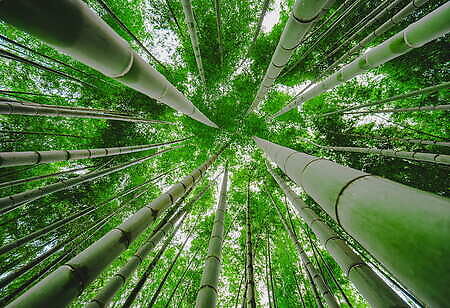
Gifting Bamboo plants in a jar to near and dear ones may be a trend followed worldwide, but it is deep rooted in the culture of China since the 11th century BC. It has taken many forms in the culture through weapons, furniture, housing, instruments, transportation, books, food, folklore and more. Likewise, the renowned scholar, Su Shi from the Song Dynasty wrote, “bamboo shoot for food, bamboo tile for house making, bamboo hat for rain sheltering, bamboo wood for fuel, bamboo skin for clothing, bamboo paper for writing and bamboo shoes for foot wearing, that is the life - we cannot do without bamboo”. Back to the present era, a Chinese YouTuber, Li Ziqi, went viral depicting the traditional lifestyle of the Chinese, particularly one video shows how to make a sofa set out of Bamboo from scratch.
Bamboo has been an important part of the country’s development. Known for its delicious taste and nutritious food, people viewed it as a treasure dish 1200 years ago during the Tang dynasty, with a famous saying, “there is no banquet without Bamboo. This is due to the protein content which is about 1.49-4.04 percent and 17 kinds of amino acids make up 35 percent of protein.
On to its constructive characteristics, Bamboo has natural firmness, tenacity, pressure-resisting, tensile strength and erosion-resisting
Varied Geographical Conditions for Growth
Judging by how China is placed on the globe, the country is located in a subtropical zone, with its southern part dunked in the tropical zone, sharing close proximity to the East Asian and South Asian monsoon zone. Additionally, it has long stretching lands with varied geographical conditions, which make the Bamboo find these attributes advantageous to their growth. Within these areas, about 500 species of Bamboo are residents, belonging to 40 genera in China and this number of species are said to outnumber the world’s population of Bamboo. As a result, from the southern part of the tropical zone to the northern part of the temperate zone, these Bamboos can be found towering the Yellow River Valley, plains, hills, mountains and alpine or subalpine altitudes of 4500 m in 24 provinces.
A Substitute for Wood
China is known as the kingdom of Bamboos as it harbours over 800 of the world’s 1,642 known species of Bamboos. On a yearly basis, the country produces over 40 million tons a year. Although wood is largely utilized, China’s forest has been reduced to 23.1 percent, with the volume of wood production to 22 percent, according to a study titled, ‘Bamboo resources and their utilization in China’. The study states that by the end of this century, the country’s wood logging will decrease from 2.6 billion m3 to 1.248 billion m3. As a substitute to all the wooden made products, the country is relying Bamboo to uplift the depleting forests. What makes Bamboo more reliable is that the plant possesses high strength, elasticity and wears resistable characteristics, taking only three to five years to grow. The plant is hassle free to manage and has strong regeneration ability.
Bamboo does have certain disadvantages such as its narrow stem, numerous internodes, low durability and vulnerability to insect attacks; however, it serves a high value regarding constructive works.
In industrial processes, bamboo is a good raw material to substitute wood. Bamboo and wood differ slightly in their anatomical structures and even their chemical make-up. It is important to conduct the required research in order to create and construct alternative technology and apparatus. Many goods can be made from bamboo, but it should be noted that bamboo-based boards work just as well in any circumstance as wood-based boards do. The technology, tools, board structure, and adhesive utilized all affect quality.
Bamboo-based composites can be created by covering them with decorative veneers made of wood or laminated coverlayers made of thermosetting plastic for decoration or strength. Additionally, to create composites, specifically of bamboo color with simplicity and elegance, delicate ornamental motifs may be woven with bamboo skin or veneer peeled from bamboos of enormous diameter. However, other than for peeling bamboo veneer, no specialized technique or equipment is required to create these composites.
Bamboo resembles wood in terms of cellulose content, chemical make-up, and fiber length. The Bamboo species such as Schizostachyum and Dendrocalamus possesses over 50 percent cellulose, with a fiber length reaching up to 3 mm.The majority of the bamboo species grown in China offer superior raw materials for making paper pulp.
In addition to being used for furniture, automobiles, packaging, and building, bamboo is also utilized to make bamboo fake board, bamboo-based composite board, bamboo parquet, and bamboo floor board. The Dai, Hani, Wa, and other tribes of people in the southern part of Yunnan province use those new sorts of bamboo-based materials in place of the conventional old bamboo houses that were constructed using unprocessed bamboo culms and rough bamboo mat. In fact Bamboo homes are believed to be more durable and solid.
Helping Oneself and Helping Others
Along with establishing its own competitive advantages in the bamboo sector, China also shares its technologies and knowledge with other nations that have abundant bamboo resources in an effort to eradicate poverty and enhance the environment.
China is actively supporting the Inter-African Smallholder Farmers Livelihood Development Programme for Bamboo in Africa, which was started by the International Bamboo and Rattan Organization (INBAR). To assist local bamboo smallholder farmers in Ghana and other African nations become more involved in the value chain of the bamboo sector, the country is sharing its experiences in the protection, planting, cutting, and management of Bamboo with them by providing training courses.
By the looks of it, China and Africa are about to build a Bamboo center in Ethiopia to conduct research and training. As a result, Africa can use this to build a better Bamboo and rattan industry.
Since Bamboo products are in low carbon and even carbon negative conditions throughout their lifestyle, it makes them capable of advancing global green development with their strong capability of carbon fixation.