


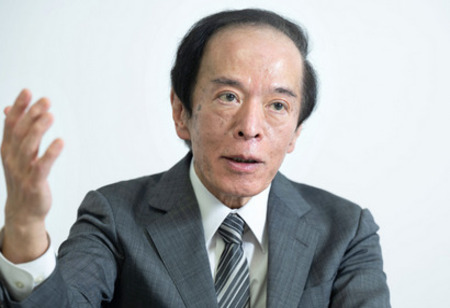
Kazuo Ueda, the governor of the Bank of Japan, announced that the central bank's decisions regarding interest rate increases will be determined by an assessment of economic and price indicators. Ueda mentioned that earlier in the day, the BOJ increased its policy rate to a 30-year peak of 0.75 percent, attributing the decision to the persistently low real interest rates.
He expressed that the current interest rate of 0.75 percent remains somewhat below the lower end of the projected neutral range.
Also Read: Hyundai Card and MoMA Unveils Bookstore in Seoul
He noted the complexity in anticipating precise levels of neutral interest rates beforehand.
Ueda commented on the pace of future interest rate hikes, stating that the central bank will carefully assess the repercussions of each increase on both the economy and inflation before making any decisions.
Japan initiated a process of policy normalization in the previous year by discontinuing the global unique system of negative interest rates that had been established in 2016. Subsequently, the BOJ has consistently upheld its position of gradually increasing rates while emphasizing the aim of fostering a beneficial cycle of increasing wages and prices.
Also Read: Chinese Robotics Firm Unitree Eyes $7 Billion IPO Valuation
Inflation has consistently exceeded the Bank of Japan's target of two percent for 44 consecutive months, with recent data indicating consumer price growth of 2.9 percent in November.
The prolonged high inflation has put pressure on real wages, which have been decreasing for 10 consecutive months as reported by the labor ministry.
The Bank of Japan forecasted that the core inflation rate, excluding the prices of perishable items, is anticipated to dip below two percent between April and September 2026. This deceleration is expected as a result of a slower increase in food prices and the implementation of governmental initiatives to counteract escalating prices.
There is a potential danger that increased interest rates may worsen the economic slowdown in Japan. Recent updates on the Gross Domestic Product (GDP) for the third quarter indicate that the economy contracted more than previously believed, with a 0.6 percent decrease on a quarterly basis and a 2.3 percent decrease on an annual basis.
Also Read: Kazakhstan President Proposes Crypto Reserve Fund
According to a statement from the Bank of Japan, although there have been signs of economic weakness, it is anticipated that corporate profits will maintain their high levels and that companies will continue to increase wages throughout 2026.
The decision to raise rates coincides with a period in which yields on Japanese Government Bonds (JGB) have reached their highest levels in decades, with further increases following the announcement, posing a potential threat of increased borrowing expenses for Japan and heightened fiscal pressures. According to the International Monetary Fund, Asia's second largest economy currently holds the world's highest debt-to-GDP ratio, which is nearly 230 percent.