


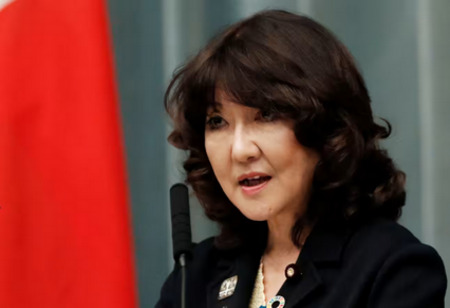
Japanese Finance Minister Satsuki Katayama expressed her concerns alongside US Treasury Secretary Scott Bessent regarding the one-sided depreciation of the yen. Katayama expressed to Bessent Japan's worry about the unilateral depreciation of the yen, which was also observed on Jan. 9, and Secretary Bessent agreed with her perspective.
Her comments were made as the yen's strength persisted, reaching a low against the dollar on Friday that hadn't been seen in a year.
Also Read: Hyundai Motor Group Chair Meets Nvidia CEO
Katayama and Bessent had discussions during a meeting of Group of Seven finance ministers and their partners on the importance of critical minerals supply chains.
The currency diplomat of Japan, Atushi Mimura, who is accompanying Katayama, informed journalists that he and his American counterpart have agreed to collaborate on foreign exchange rates as necessary and to stay in regular communication regarding the situation.
Furthermore, Finance ministers from the G7 countries decided to speed up efforts to decrease their excessive dependence on China for essential minerals. The agreement was announced by Japanese Finance Minister Satsuki Katayama after a meeting in Washington that included representatives from Australia, India, Mexico, and South Korea. They also discussed the implementation of new policies to create alternative supply chains for these critical minerals.
The US Treasury Department said the participants "expressed a strong, shared desire to quickly address key vulnerabilities in critical minerals supply chains" throughout the course of discussions.
The department stated that the US Treasury Secretary Scott Bessent expressed hope that they will focus on cautious risk reduction instead of decoupling, and that they have a good understanding of the importance of fixing existing shortcomings in critical minerals supply chains. The gathering, organized by Bessent and attended by US Trade Representative Jamieson Greer, occurred as China utilized its control over rare earth mineral processing to influence diplomatic and economic situations.
Also Read: Li Qiang Urges Decisive Actions, More to Ignite Economic Growth
Last week, China implemented stricter restrictions on the export of dual-use items to Japan, which could potentially include rare earths that have both civilian and military uses. Since Japanese Prime Minister Sanae Takaichi made comments in parliament in November indicating that an attack on Taiwan could result in a response from Japan's defense forces, Beijing has been directing its attention towards Tokyo.
Katayama informed the media that she had detailed Japan's stance on Chinese export regulations to her colleagues and shared the country's expertise on reducing reliance on China for rare earths to around 60 percent from approximately 90 percent after Beijing implemented an export restriction in 2010 due to a territorial disagreement. Katayama and Japanese officials stated that during the discussions, the focus was on the significance of establishing minimum prices and developing a market that upholds standards for both labor and human rights.
Also Read: Japan's Cabinet Approves Record $785 Billion Budget
This was prompted by concerns that China has been able to provide cheap rare earths by exploiting its low-wage and substandard working conditions. She observed that the countries involved make up over 60 percent of the worldwide demand for rare earths and proposed that improved collaboration among them could benefit supply chains.