


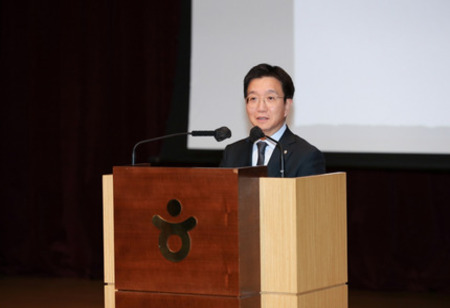
The recently appointed chief executive of the Korea Tourism Organization (KTO) introduced a proactive strategy to expedite the growth of tourism, committing to achieve the government's target of 30 million yearly visitors ahead of the projected timeline.
CEO Park Sung-hyeuck declared that reaching the milestone of 30 million visitors would occur by the year 2028, emphasizing the urgency to act before the year 2030.
Also Read: Japan to Hold Ministerial-Level Health Talks With China, S.Korea
The declaration signifies a notable change in the country's tourism plan, as the Korea Tourism Organization (KTO) designates 2026 as the pivotal year for an extensive overhaul centered on three main components: drawing in tourists, prolonging their visits, and assimilating artificial intelligence (AI).
Park, a marketing expert hired from Cheil Worldwide, a marketing department of Samsung Group, where he spearheaded the international market strategy, emphasized the importance of the goal by pointing out that Korea welcomed a historic 18.9 million international tourists last year.
The numerical data illustrates a growth of 15.7 percent compared to the previous year and an 8.2 percent increase over the peak in 2019 before the pandemic. To achieve a target of 30 million visitors by 2028, there would need to be a consistent annual growth rate exceeding 16 percent, a goal that Park has deemed as ambitious yet essential.
The newly appointed head of KTO directly acknowledged the disparity between Korea and Japan, referencing research indicating that Korea attracts approximately half the number of tourists as Japan and only a third of the bilateral travel between the two countries.
Park emphasized the urgency of rectifying the existing imbalance, proposing a strategic approach that focuses on diversifying regionally and tapping into more lucrative markets.
Park focused on qualitative growth rather than solely chasing after quantity. Their attention was on premium sectors such as medical wellness, beauty tourism, and major international conferences. According to him, while volume is a crucial factor, the true measure of success lies in the duration of visitors' stay and the extent of their consumption.
Also Read: Minister Eyes Downstreaming to Boost Spice Competitiveness
KTO will implement market-specific strategies customized to suit the unique features of each region. In the case of China, Japan, and Taiwan - Korea's primary markets - the emphasis will be on promoting tourism in secondary cities and encouraging repeat visits. Southeast Asia and the Middle East will be reached through offerings that showcase K-culture, whereas North America and Europe will experience an increase in both online and offline channels to attract new demand.
Park detailed 10 key projects for 2026, one of which involves the integration of AI technology into Korea's tourism guidance system by the year 2028. The Korea Tourism Organization (KTO) plans to centralize 13 separate websites into a unified "Visit Korea" portal, create an AI-powered travel companion with language support, and launch combined tourism and transportation passes for travelers from overseas.
Park made a commitment to transcend negotiations at the local level and instead focus on creating significant partnerships with renowned global hotel chains like Hilton and Marriott, as well as leading online travel agencies at the corporate level. This strategy aims to enhance Korea's presence in international markets by capitalizing on the cascade effects of such collaborations.
Also Read: VML Vietnam Appoints Bao Tu Chief Innovation Officer
Within the country, KTO plans to launch regional holiday initiatives that will provide a 50 percent reimbursement on travel costs to rural communities facing population decline in 20 specified areas. This initiative aims to tackle issues related to both tourism dispersal and demographic shifts.
“2026 will be a year of transformation where we execute based on data and create tangible results that people experience on the ground,” Park says. “Just as Japan’s tourism industry ranks second (in Japan’s export sector), we will elevate Korea’s tourism to become one of our three major export industries within three years,” he adds, referring to automobiles and semiconductors as the country’s major export industries.