


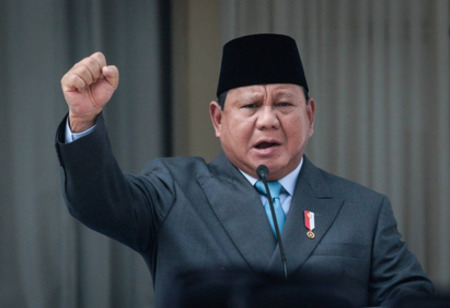
President Prabowo Subianto has advised government officials to construct intricate and graduated food security systems, which includes creating food warehouses that operate all the way to the village level. He provided guidance during a meeting with local officials from Papua and the Executive Committee for accelerating the development of special autonomy in Papua.
Prabowo pointed to the recent flood disasters in Sumatra as a poignant illustration of the crucial role of local food reserves in ensuring regional resilience during times of crisis.
Also Read: Japan Defense Chief Considers US Trip to Advance Cooperation
"We must have food barns down to the village level, from villages and districts to provinces, supported by national food barns," he says.
"We will help ensure every district achieves food self-sufficiency."
The president underscored the importance of food security as a fundamental cornerstone of national survival, highlighting that history demonstrates the resilience of nations and civilizations is contingent upon robust and self-sufficient food systems.
"The foundation of a nation lies in its ability to provide food for its people. Therefore, food self-sufficiency is the basis of our national transformation," he adds.
Prabowo emphasized the necessity of expediting the holistic development of Papua in various sectors, with a particular focus on establishing food security as its primary foundation.
Also Read: Vietnamese Party Chief Visits Former Top Leaders of Laos
The Agriculture Minister, Andi Amran Sulaiman, expressed that the government's objective is to attain self-sufficiency in food production in Papua within the coming three years.
"We must have the courage to correct systems that do not align with the vision of our founding fathers. For Papua in particular, development must be accelerated in all sectors," he says.
The objective will be achieved by establishing new rice fields and enhancing the efficiency of local staple food production, with a specific focus on sago.
Previously, it was stated by Coordinating Minister for Food Affairs Zulkifli Hasan that Indonesia's decision to prohibit rice imports has played a role in the reduction of global rice prices. Hasan highlighted that Indonesia had formerly been a major player in rice imports on a global scale prior to altering their approach to prioritize heightened domestic production during President Prabowo Subianto's term in office.
Hasan observed that Indonesia's rice importation last year amounted to 4.5 million tons, contrasting sharply with a surplus of 4.7 million tons in 2025. The state-operated logistics enterprise Bulog presently maintains a rice inventory of approximately 3.7 million tons. Figures released by the Coordinating Ministry for Food Affairs indicate that the country's rice yield for the current year has escalated to 34.77 million tons, denoting a marked uptick of 13.54 percent from the previous year.
Also Read: Ministry Urges Comprehensive Food, Nutrition Development
The ministry reported an increase in corn production to 16.55 million tons for the current year, representing a growth of 9.34 percent compared to the previous year. Hasan credited this improvement to the streamlining of regulations, specifically in the procurement and distribution of subsidized fertilizers, enabling farmers to access supplies in a timely manner for planting.