


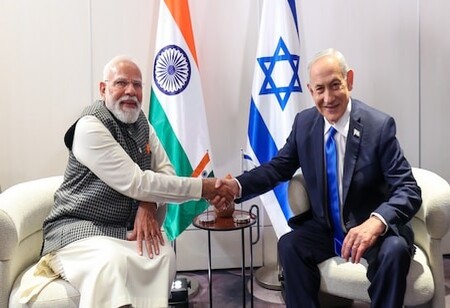
India and Israel upgraded their relationship to a strategic partnership during Prime Minister Narendra Modi's visit to Israel in July 2017. Since then, both countries have established a robust collaboration across various sectors including science & technology, innovation, defense & security, trade & investment, agriculture, water management, and cultural exchanges.
In recent years, the partnership has experienced renewed vigor, especially in areas like defense, scientific research, cybersecurity, and innovation. Defense collaboration has become a fundamental component, with Israel providing India with a diverse array of military platforms and weapon systems.
India and Israel have initiated their inaugural round of discussions regarding a proposed free trade agreement (FTA), indicating a desire to enhance economic collaboration as New Delhi intensifies its efforts to establish market access partnerships with significant technology-driven nations. These negotiations follow the establishment of the terms of reference in November 2025, which set forth a framework for talks in designated areas aimed at increasing trade and economic cooperation.
PM Modi’s Two-Day Visit to Israel
The development is notable as Prime Minister Narendra Modi undertakes a two-day state visit to Israel starting from February 25 at the invitation of Israeli Prime Minister Benjamin Netanyahu. This marks Modi’s second trip to Israel, highlighting the increasing strategic and economic depth in the relationship between the two nations. In the fiscal year 2025, merchandise trade between India and Israel reached $3.65 billion. Both countries possess complementary strengths in various sectors, and the trade agreement is anticipated to act as a catalyst for further increasing bilateral trade, according to the ministry. The proposed pact is expected to offer more certainty and predictability for businesses, including small and medium enterprises, through clearer regulations and enhanced market access commitments.
As stated by the commerce ministry, technical teams are engaging in discussions covering a wide variety of topics, including trade in goods and services, rules of origin, sanitary and phytosanitary measures, technical barriers to trade, customs procedures and trade facilitation, and intellectual property rights. During the opening session, commerce secretary Rajesh Agrawal mentioned that the negotiations are beginning at a favorable time, aligning with the Prime Minister's visit to Israel. He emphasized the potential in areas such as innovation, science and technology, artificial intelligence, cybersecurity, high-tech manufacturing, agriculture, and services, pointing out that the FTA could enable both parties to leverage their strengths more effectively.
India's lead negotiator Ajay Bhadoo, who serves as additional secretary in the commerce ministry, emphasized the need for a balanced agreement that establishes a progressive framework for a developing partnership. Israel's lead negotiator Yifat Alon Perel, the senior director for trade policy and agreements and deputy trade commissioner, noted that the agreement could strengthen supply chains, improve collaboration, and unlock new market opportunities.
Also Read: 5 CMO Appointments in Companies across Asia in November 2025
For India, discussions with Israel are taking place during a busy FTA schedule that features ongoing negotiations and assessments with key partners. New Delhi has been placing greater emphasis on agreements that promote technology transfer, value-chain integration, and services exports, instead of merely focusing on tariff reductions. Israel, recognized for its capabilities in agri-tech, water management, defense technologies, and vibrant startup ecosystems, is viewed as a strategic ally in areas that correspond with India’s goals in manufacturing and digital sectors.
Trade specialists noted that, although trade between India and Israel is relatively small in comparison to its larger trading partners, it is characterized by a focus on technology and investment.
“A free trade agreement could facilitate the reduction of both tariff and non-tariff obstacles, lessen regulatory challenges, and establish a framework for cooperation in emerging fields such as AI and cybersecurity, where both nations possess complementary strengths,” stated Ajay Sahai, director general of the Federation of Indian Exporters Organisation (Fieo).
Over the last three fiscal years, India's merchandise trade with Israel has experienced a significant downturn, with exports dropping notably from their peak in FY23, while imports have decreased more gradually.
India-Israel Export Deal
India's exports to Israel reached $8.45 billion in FY23, but dropped to $4.53 billion in FY24 and further declined to $2.15 billion in FY25, according to data from the commerce ministry. This represents a decrease of approximately 46percent in FY24 compared to FY23, followed by an additional 53percent reduction in FY25. In total, India's exports to Israel have fallen by almost 75percent from FY23 to FY25, as indicated by the data.
On the import front, India acquired Israeli products worth $2.32 billion in FY23, which fell to $2.01 billion in FY24, reflecting a decrease of 13.6percent, and then down to $1.48 billion in FY25, which is a 26percent drop, according to the ministry's data. Over the course of two years, imports have decreased by just over 36percent.
Also Read: Trend Watch: Asian Startup & Tech Leaders' Expectations for 2026
India has managed to keep a trade surplus with Israel, although the difference has significantly decreased. The trade surplus stood at $6.13 billion in FY23, reduced to $2.52 billion in FY24, and further diminished to $0.66 billion in FY25, according to data from the ministry. In a different event on Tuesday, commerce and industry minister Piyush Goyal stated that India is establishing “bridges of trade, trust, and transformation” during a period of global uncertainty, and it now has preferential access to almost two-thirds of global trade thanks to a series of high-quality FTAs signed under the Prime Minister's guidance.
Also Read: Vision to Reality: How Middle East is Leading in AI Innovation
While speaking virtually at the 5th CII National Exports Competitiveness Summit in Chennai, Goyal mentioned that all nine Free Trade Agreements (FTAs) made under the present government have been with developed nations that support India's growth trajectory. He emphasized that no nation can achieve developed status without embracing the global economy and reaffirmed the government's dedication to reform, perform, and transform. Goyal pointed out the rapid pace of engagement, noting that he participated in three FTA-related discussions in just six hours, which included initiating negotiations with the Gulf Cooperation Council, meeting with the Israeli negotiating team to advance FTA talks, and preparing for discussions with Chile to secure access to essential minerals.