


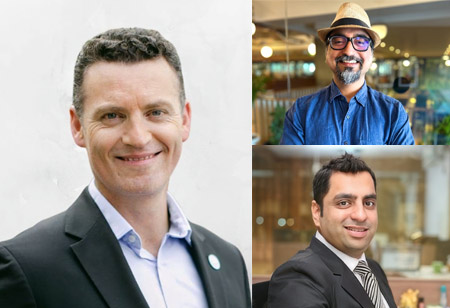
Startup founders and technology executives are entering 2026 with increased expectations concerning artificial intelligence, data intelligence, cybersecurity, and the commercialization of deep tech. Besides, they foresee intensified scrutiny from regulators, investors, and customers, who will demand transparency, ethical tech usage, and measurable results.
Talent strategies are also transforming, with leaders rethinking hybrid work arrangements, upskilling initiatives, and leadership culture to create organizations that are ready for the future in a competitive global landscape. As they look forward, startup and technology leaders regard 2026 as a year of strategic clarity where ambitious ideas must evolve into scalable solutions, and innovation must tackle real-world issues across various industries and communities.
Let’s look into the perspectives of senior startup and technology leaders about 2026.
Rob Newell, Senior Vice President and General Manager, Asia Pacific & Japan at New Relic
 "Only 16 months after Crowdstrike brought the digital world to a standstill, and a month after the global AWS outage, this week another key player in the Cybersecurity space, Cloudflare, suffered a global outage causing error messages to plague websites across the globe, including Spotify, ChatGPT, X, and Open AI.”
Also Read: 5 Key CTO Appointments in Asia for October 2025
“Outages of this size can have significant impacts on an organization’s bottom line. The 2025 Observability forecast found that high-impact outages can cost Indian organization’s between $1M-$3M USD in lost revenue per hour. In the case of the recent global AWS outage, New Relic’s engineers were able to flag the issue 27 minutes before AWS informed their customers of the outage, enabling New Relic's customers to identify the impacted services of their stack so they could address issues efficiently, and monitor golden signals within the failover environment to ensure its stability and performance. With global outages becoming more common, observability is no longer an engineering tool––it is business-critical practice."
Raj K Gopalakrishnan, Co-founder & CEO, KOGO AI
 “2026 is when enterprise AI separates into two categories: those who own their advantage, and those who rent it. The winners won’t be running the most AI tools—they’ll own their complete AI process IP. Every prompt refined, every workflow optimized, every fine-tune deployed—that’s compound interest on your competitive advantage, and you can’t build it on borrowed infrastructure.”
“We’re past the co-pilot era. Enterprises are waking up to a hard truth: sovereign deployment isn’t a compliance checkbox, it’s your moat. The moment your AI logic, your data, your improvement cycles live in someone else’s environment; you’re training their models and funding your competitor’s advantage. By 2026, Chairmen won’t ask ‘should we do AI’—they’ll ask ‘do we own the OS, own the agent, own the outcome, or are we just licensing our future from someone else’s cloud?’ Private AI isn’t a trend. It’s the control plane for building an advantage that actually compounds.”
Vishal Rajani, Founder & CEO, Synergos
 “As the founder of a digital marketing company that’s empowered hundreds of brands to connect with their customers, here’s my unfiltered take on what actually wins in 2026.
India is catapulting towards digital dominance, and it is set to become the world’s third-largest economy by 2027. The upcoming year (2026) demands a major shift in digital marketing strategies as AI is suddenly everyone’s new best friend. 2026 won’t be about “using AI.” It will be about leveraging AI that knows your customer and anticipates their needs like a sixth sense. Cookie-cutter campaigns are dead. We’re talking hyper-personalized experiences at scale: dynamic creatives, pricing, even product recommendations that shift in real-time based on mood, weather, and wallet thickness.”
Also Read: 5 CMO Appointments in Companies across Asia in November 2025
Here’s where the world will move from SEO to GEO or Generative Engine Optimization: the new sheriff in town. With AI-powered search engines like Gemini and Perplexity, brands will have to optimize for conversational queries, not merely keywords. This means creating digital marketing content that answers the “whys” and “hows” in real-time, capturing voice and visual searches. If content in 2026 isn’t written to be quoted, summarized, and cited by Gemini, ChatGPT, and Perplexity, brands will have a tough time existing in an AI-driven market. Brands that master conversational, citation-worthy content will own the marketing funnel.”
“And yet, the biggest paradox is already playing out. The more advanced the technology, the more desperately people crave the human touch. We expect to see digital marketing moving towards raw, community-fueled storytelling."
Also Read: Look back 2025: Top 10 Leadership Transitions across Asia
"For example, Zomato’s user-generated victory feasts during cricket matches, where fans post mukbangs of samosas and biryani, turned meals into community celebrations of national pride. Combine this with transparent data practices, and brands won’t just earn attention, they’ll grab devotion and amplify genuine human connections over scripted perfection.”
“In India, 2026 belongs to digital marketers and brands brave enough to use AI as a megaphone to tell authentic stories that resonate with the common man. For Indian marketers, the era of shouting into the void is dead. Build trust, own your data, speak with empathy, build genuine connections and let AI amplify the magic.”