


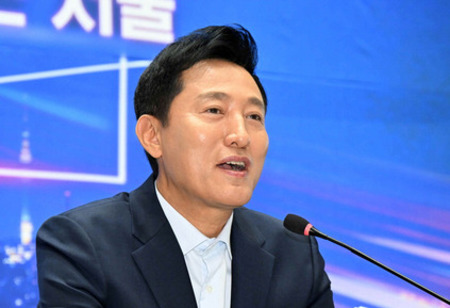
This year Seoul will introduce its first completely autonomous robotaxis, marking a significant milestone in the city's endeavor to establish itself as a frontrunner in the implementation of tangible artificial intelligence (AI) in various physical environments, such as streets, structures, and public amenities, says Mayor Oh Se-hoon at the recent AI Seoul conference held at COEX.
The Mayor emphasized Seoul's role as a major testing ground for AI applications in urban environments, highlighting the city's focus beyond digital interfaces.
Also Read: Energy Minister Hints on Possible Gasoline Import Halt by 2027
He outlined the city government's plans to implement extensive urban trials to showcase the potential of AI technology in enhancing daily life experiences for its residents. Oh outlined a three-pronged approach to achieve this vision.
Commencing in October, Seoul will unveil its first Level 4 robotaxis, marking Korea as the third global city to embrace this cutting-edge technology. A Level 4 vehicle is capable of autonomous operation within specific constraints without the need for human interference. By the conclusion of this year, there will be a collective of 18 semi-autonomous buses, classified as Level 3, in operation on various routes throughout Seoul.
The second foundation of this initiative is known as the "Seoul Physical AI Belt," which involves the enlargement of the current Yangjae AI cluster. This cluster is home to over 400 AI start-ups and research institutions and will also establish a specialized area for robotics centered around Suseo Station. The Seoul Metropolitan Government is intending to commence the expansion in the year 2028. It has been stated that the robot venture town, comprising research facilities and a theme park, is projected to be finalized by 2030.
Also Read: Japan's Katayama Shares Concern Over Weak Yen With Bessent
According to reports, the objective is to transform Seoul into a thriving industrial hub that benefits from the integration of physical artificial intelligence, rather than merely serving as a location for such technology.
The city government plans to allocate 70 billion won ($49 million) by 2030 to expedite research and development in physical AI, while also creating a 150-billion-won "Vision 2030 Fund" to support promising companies within this sector.
This initiative aims to support not only fundamental technologies in the field but also emerging startups capable of converting these technologies into tangible services and products.
In urban settings, tangible artificial intelligence technology will be integrated throughout various aspects of city infrastructure and functions, including sophisticated transportation services such as traffic management and emergency preparedness, as well as subterranean logistics distribution systems and energy regulation. As part of this initiative, Seoul seeks to establish itself as a technologically advanced city that welcomes the incorporation of robotic solutions, while also forging collaborations with prominent AI hubs like New York, Paris, and Shanghai.
Also Read: Ministry Aims to Reduce Agricultural Burning by 15 Percent
To bridge the gaps in healthcare resulting from the increasing number of elderly residents, the city intends to enhance its human services with the integration of physical artificial intelligence technology. This initiative will involve the broader adoption of rehabilitation and mobility assistance robots, in addition to wearable robotic devices designed to boost physical strength.
Furthermore, the city is set to bolster its safety measures by employing AI-enabled fire patrol robots and drones for surveillance tasks. To increase public understanding of the technology and its possibilities, authorities will organize events like the "Seoul AI Festa" in late February and the "Seoul Robot Show" scheduled for October.
At this year's Consumer Electronics Show (CES) in Las Vegas, held from January 6th to 9th, the focus shifted to the emergence of physical artificial intelligence, as humanoid robots showcased their ability to perform complex tasks. During the conference, Jensen Huang, the CEO of NVIDIA, proclaimed that the era of advanced physical AI has now reached a significant milestone.