


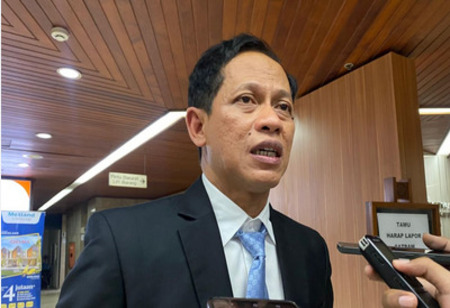
Minister of Environment Hanif Faisol Nurofiq cautioned the business sector about the importance of prioritizing environmental protection as a core principle. He emphasized the significant economic and social implications of disasters resulting from human activities.
Nurofiq commented on the recent occurrences of flooding in Sumatra and a landslide in Cisarua, attributing them in part to human actions that did not consider the effects of the climate crisis.
Also Read: Modernizing Public Healthcare a Priority this Year: Dzulkefly
“We need collaboration to raise awareness that whatever economic activities we undertake, if we fail to put the environment as the main foundation, the cost of recovery and the cost of damage will be extremely high,” Nurofiq said at the ESG Sustainability Forum 2026 in Jakarta.
He emphasized how these actions have contributed to an increased probability of natural phenomena such as more severe weather events. He mentioned projections from the National Disaster Management Agency (BNPB) in early December 2025, indicating that the cost of repairing flood damage in Sumatra could potentially reach Rp51.82 trillion (equivalent to about US$3.1 billion).
The mentioned amount does not account for the losses incurred from disasters in three provinces spanning Sumatra. Additionally, the Center of Economic and Law Studies (Celios) has independently estimated that the total losses amount to approximately Rp68.67 trillion (equivalent to about US$4.1 billion).
Also Read: PM Calls for Stronger Decentralization for Stalled Projects
Nurofiq observed that the numbers provided exclusively represent tangible damages and fail to incorporate intangible consequences such as loss of life. BNPB's statistics as of February 3 indicated a death toll of 1,204.
“We urge companies and all Indonesians that the time has come for us to reaffirm ourselves as a nation capable of facing all development challenges. Not only physical challenges, but also global ones in which we are among the most affected, climate change”, he says.
Nurofiq urged all sectors of society, including corporations, to implement tangible actions based on mitigation and adaptation strategies, emphasizing the importance of moving beyond mere forums and dialogues.
The Ministry of Environment in Indonesia is currently overseeing operations of 68 companies in Aceh, North Sumatra, and West Sumatra as a strategic measure to prevent or reduce the impact of hydrometeorological disasters in the area. The ministry employs law enforcement measures rooted in spatial data, field verification, and scientific evidence when responding to hydrometeorological disasters from an environmental perspective.
Also Read: Ministry Explores Skilled Worker Placement With IM Japan
The Ministry of Environment in Indonesia is currently overseeing operations of 68 companies in Aceh, North Sumatra, and West Sumatra as a strategic measure to prevent or reduce the impact of hydrometeorological disasters in the area. The ministry employs law enforcement measures rooted in spatial data, field verification, and scientific evidence when responding to hydrometeorological disasters from an environmental perspective.