


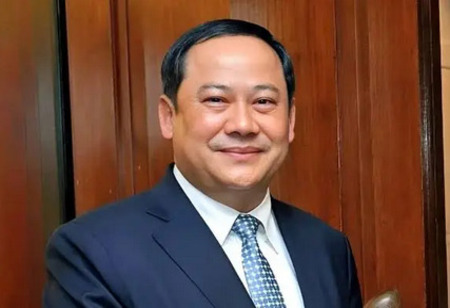
Prime Minister Sonexay Siphandone has delineated an extensive plan aimed at modernizing revenue collection and enhancing fiscal discipline. This underscores the government's commitment to developing a self-sufficient economy and positioning Laos as an upper-middle-income nation by 2035.
The Prime Minister emphasized the importance of significant modifications to revenue collection methods in order to achieve economic self-sufficiency and ensure sustained long-term growth, during the conclusion of a national finance conference that reviewed achievements in 2025 and set milestones for 2026. The government plans to establish a structured, transparent, and centralized electronic revenue collection system, utilizing cutting-edge technology and fostering enhanced collaboration among various pertinent industries.
Also Read: Indonesia, Bosnia and Herzegovina Ink MoU on Defense Cooperation
As a component of this initiative, the electronic invoicing system will be extended to all enterprises, with the D-Filing system being fully integrated to facilitate electronic submission of forms, distribution of funds, and the gathering of fees and service charges. Revenue collection at international border checkpoints will be centralized under the Ministry of Finance's FinPass system, with revenue management systems in various sectors being linked to enhance data sharing and supervision.
The prime minister has directed the appropriate agencies to reassess the allocation of budget oversight responsibilities between the central and local governments, proposing that oversight of major corporations be shifted to the central government to enhance oversight capabilities.
In addition to proposing institutional changes, the prime minister highlighted important financial objectives for the year 2026, such as aiming for a 5.5 percent increase in GDP, generating revenue equivalent to at least 20 percent of GDP, and securing higher contributions from state-owned enterprises, set at approximately one percent of GDP.
In the foreseeable future, the government's objective is to sustain an average economic growth rate of six percent or higher between the years 2026 and 2030. Minister of Finance Santiphab Phomvihane provided an in-depth analysis of the recent economic progress and financial projections, emphasizing that Laos is steadily progressing towards achieving its 2035 development objectives.
Also Read: Lee to Visit Japan's Nara Next Week for Summit Talks with Takaichi
Santiphab stated that the government's ultimate goal is for Laos to achieve upper-middle-income status by 2035 through continuing growth, fiscal restructuring, and targeted advancement in critical sectors. To accomplish this objective, there is a targeted increase in per capita income to US$4,600-US$5,000 annually, supported by a projected average annual economic growth rate of six to seven percent.
Efforts in development will concentrate on seven key economic sectors, which are anticipated to have a significant impact on the restructuring of the economy and the sustainable enhancement of productivity. The finance minister, in scrutinizing the recent performance, stated that the state budget plan for 2025, marking the culmination of the 9th five-year National Socio-Economic Development Plan (2021-2025), demonstrated consistent advancement in the face of a complex global landscape. Inflation has been effectively managed, declining to a single-digit level of 8.8 percent, with macroeconomic stability remaining solid.
Also Read: Kenvue Appoints Madhav Nayak as VP and CMO for APAC
The poverty alleviation goals outlined in the strategy have been successfully met, laying a robust groundwork for the upcoming phase of growth. In anticipation of the year 2026, Santiphab stated that the government intends to execute the 10th National Socio-Economic Development Plan, highlighting the importance of enhancing fiscal discipline and enhancing revenue collection to ensure that revenue constitutes 20.02 percent of the Gross Domestic Product (GDP).
Efforts to collect revenue will be concentrated on enhancing customs duties and other tax types, establishing fresh revenue streams, and augmenting the proceeds derived from logistics services. Sophisticated and advanced tools for revenue collection will be employed, with a gradual reduction in tax and customs duty exemptions that are not aligned with current regulations. Budget expenditures will be closely regulated at every phase, ranging from initial planning and allocation to monitoring and auditing, in order to guarantee the efficient utilization of scarce financial resources in accordance with national priorities.