



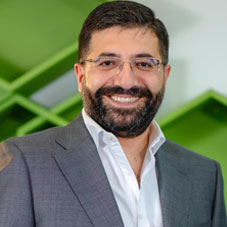
Arsen Babayan
Chief Technology Officer
In today's financial services industry, technology has become a strategic enabler of innovation, operational resilience, and customer trust. As institutions accelerate their digital transformation journeys through artificial intelligence, cloud computing, automation, and data-driven decision-making, the role of the Chief Technology Officer (CTO) has evolved into one of the most influential positions within the enterprise.
In an industry where speed, security, and reliability must coexist, effective technology leadership has become a critical competitive differentiator. Among the leaders driving this transformation is Arsen Babayan, Chief Technology Officer at Ineco Group, whose more than two decades of experience reflect a leadership journey defined by continuous evolution— from hands-on engineering and team leadership to enterprise-wide strategy, organizational design, and business-driven technology innovation.
A defining milestone in Arsen Babayan’s career was his early commitment to people leadership and organizational development. This focus established a foundation where personal achievements became secondary to the success, growth, and performance of his team.
As his leadership responsibilities expanded, he embraced the challenge of managing managers, learning to empower leaders rather than directly overseeing engineers. By creating the right structures, guidance, and autonomy, he enabled his managers to build and lead high-performing teams independently.
As CTO, Babayan's focus has naturally shifted toward organizational strategy, technology vision, and long-term business alignment. His leadership emphasizes designing technology organizations that not only deliver engineering excellence but also contribute meaningfully to broader business objectives. CEO Insights engaged in a one-on-one interaction with Arsen Babayan, let’s hear from him.
My focus is on establishing clear governance, defining where AI can operate autonomously, and ensuring people continue to provide oversight, ethics, and strategic direction
Technology is advancing at an unprecedented pace, particularly with AI becoming central to business transformation. How do you evaluate which emerging technologies are worth investing in, and which are simply passing trends?
I evaluate every emerging technology through the lens of business value rather than market excitement. The first question I ask is whether it solves a genuine, recurring problem for customers or improves operational efficiency. If the answer is no, it is not worth pursuing. I also consider how easily it integrates into existing engineering workflows because even the best technology fails if adoption is difficult.
For example, AI-powered coding assistants and automated support triage offer immediate value with minimal disruption, whereas fully autonomous AI systems for critical production tasks still require greater maturity before widespread adoption.
How do you build high-performing teams? What leadership principles have helped you cultivate a culture of innovation, collaboration, and continuous learning?
For me, high-performing teams are built on clarity, trust, and ownership. I ensure everyone understands why we are solving a problem while giving engineers the freedom to decide how to solve it. Innovation thrives when people feel safe to experiment without fearing mistakes.
At the same time, continuous learning must be intentional rather than incidental. I encourage structured learning through hackathons, cross-functional projects, and dedicated upskilling opportunities, making knowledge sharing an integral part of the team's responsibilities instead of an optional activity.
As organizations increasingly operate across distributed and global teams, what practices have you found most effective for maintaining engineering excellence and strong collaboration?
Leading distributed teams requires designing processes around asynchronous collaboration rather than meetings across time zones. I believe engineering excellence depends on providing every developer with consistent experience through standardized environments, strong DevOps practices, automated testing, and seamless continuous integration.
At the same time, I reserve live interactions for strategic discussions, problem-solving, and relationship building instead of routine updates. Documentation and dashboards should handle operational communication, while real-time conversations should strengthen trust, alignment, and team cohesion.
Looking ahead, which technologies do you believe will have the greatest impact on businesses over the next five to ten years?
I believe the next decade will move beyond today's AI models toward more advanced technologies capable of deeper reasoning and decision-making. Neuro-symbolic AI and post-transformer architectures have the potential to tackle far more complex business and scientific challenges. I also expect hybrid quantum-classical computing to become commercially relevant for specialized workloads such as optimization and simulation.
Alongside these advances, cybersecurity will undergo a major transformation, with Zero- Trust architectures and AI-driven security becoming essential to protect organizations from increasingly sophisticated threats.
What do you believe will be the defining priorities for CTOs over the next decade, and how are you preparing your organization to succeed in that future?
The role of the CTO will increasingly focus on ensuring technology solves the right business problems rather than simply accelerating delivery. As AI removes many implementation barriers, I believe engineers must become more closely connected to product strategy and customer needs.
Another priority is building an effective human-AI workforce where automation complements, rather than replaces, human judgment. My focus is on establishing clear governance, defining where AI can operate autonomously, and ensuring people continue to provide oversight, ethics, and strategic direction.
What is the next chapter you look forward to embarking on in your professional journey?
The next phase of my journey is centered on driving large-scale transformation in financial technology with Ineco Group. The financial services industry presents a unique opportunity because it demands continuous innovation while maintaining the highest standards of security, reliability, and trust.
My goal is to help the organization build on its strong technology foundation, expand into new markets, and create scalable digital solutions that support long-term growth while delivering exceptional value to customers and partners.
Arsen Babayan, Chief Technology Officer, Ineco Group
Arsen Babayan is the Chief Technology Officer at Ineco Group, bringing nearly two decades of experience in engineering leadership, technology strategy, and organizational transformation. He specializes in building high-performing teams, driving AI-enabled innovation, and aligning technology with business goals to deliver scalable, secure, and customer-centric financial solutions.