


.png)
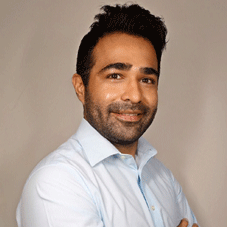
Jatin Lalwani
CEO, Market Reach International Resources
Leaders from the Philippines have carved a strong presence in the export and global distribution of FMCG, driven by their ability to adapt to diverse international markets while maintaining deep-rooted local insights. Operating within a highly dynamic trade environment, Filipino leaders have demonstrated expertise in building efficient supply chains, managing cross-border logistics, and responding to rapidly evolving consumer preferences.
Their approach is often defined by resilience, relationship-building, and a keen understanding of both regional and global demand patterns. As the FMCG sector becomes increasingly competitive, these leaders continue to play a pivotal role in connecting markets, optimizing distribution networks, and delivering value across geographies.
Reflecting a similar global mindset and entrepreneurial resilience, Jatin Lalwani has established himself as a forward-thinking leader in the FMCG distribution and international trade landscape. His journey began nearly two decades ago when he chose to step away from his family business to build an independent venture from the ground up. Entering the FMCG distribution space, he steadily scaled operations by expanding into new markets and assembling a strong, capable team.
Over time, Lalwani developed deep expertise in global trade, logistics, and supply chain management, alongside a nuanced understanding of the geopolitical factors that shape international markets. Under his leadership, Market Reach International Resources has evolved into a diversified enterprise spanning FMCG imports and exports, as well as agriculture and commodities trading.
His leadership philosophy is rooted in the belief that success is shaped not only by knowledge but by the ability to navigate challenges that test intellectual, emotional, and adversity quotient. This perspective continues to guide his organization as it adapts to the complexities of today’s fast-evolving global business environment.
What key factors influence your decision-making process when it comes to major business strategies and initiatives?
Most leaders suffer from too much information and too little conviction. The real bottleneck in decision-making isn’t data, it’s the courage to act on an incomplete picture. My process blends two things: deep intuition built from years of pattern recognition in volatile markets, and deliberate consultation with a tight circle of people who will challenge me, not validate me. I don’t want consensus, I want honest friction. The decisions I’ve gotten wrong were the ones where I let noise drown out instinct, or sought comfort instead of clarity.
With globalization playing an increasing role, how do you see emerging markets affecting your business strategy and how are you preparing for these shifts?
The old model, find a reliable supply chain, optimize it, protect it, is finished. COVID didn’t break globalization; it exposed that we had confused efficiency for resilience. My answer is deliberate diversification, but with discipline: you diversify because your core is strong enough to bear it, not because you’re scared. For us, that means moving upstream and downstream simultaneously, entering adjacent verticals with transferable capabilities, and reducing dependency on any single geography. The businesses that survive the next decade won’t be the most connected: they’ll be the most antifragile.
How are you incorporating new technologies (e.g., AI, data analytics, automation) to stay competitive in the market?
Honestly, we’re not yet a technology company. But we’re using AI the way most operators should right now to compress time. Faster synthesis of market data, sharper presentations, leaner workflows. The real unlock isn’t automation for its own sake; it’s reclaiming the cognitive bandwidth to think strategically instead of operationally. What excites me more than the tools is what AI does to the competitive landscape, it will commoditize execution and reward judgment. If you’re not building better decision-making capacity into your organization now, you’re quietly falling behind.
AI will commoditize execution and reward judgment. If you’re not building better decision-making capacity into your organization right now, you’re quietly falling behind
How does sustainability factor into your business strategy, and are there any specific initiatives you are pursuing to promote sustainability?
Sustainability isn’t yet a core pillar of our strategy, but it’s becoming a commercial reality, not just a moral one. Consumers are voting with their wallet, regulators are tightening, and supply chain partners are screening on ESG criteria. We’ve made foundational moves, waste reduction, packaging optimization, sourcing from suppliers with recyclable materials. I see this less as compliance and more as early-mover opportunity. The brands that embed sustainability now will have structural cost and reputational advantages within five years. I’d rather be building that moat today than reacting to it tomorrow.
How do you foresee the expectations of your clients evolving in the next few years, and what steps are you taking to stay ahead of these demands?
The next consumer cohort is the most informed, most skeptical, and most values-driven in history. They don’t just buy products; they buy into narratives. Health, provenance, sustainability, and experience aren’t premium features anymore they’re table stakes. Our product portfolio can never be static. We’re not just distributors; we’re curators of what’s next. Where the market doesn’t yet offer what consumers are moving toward, we build it ourselves. The brands that will win aren’t the ones with the best distribution, they’re the ones that understand where culture is going before it gets there.
What key opportunities do you see in the near future, and how do you plan to capitalize on them?
The biggest white space is at the intersection of wellness, longevity, and natural products, not as a trend, but as a structural shift in how people define value. This isn’t niche anymore; it’s going mainstream, and most distribution infrastructure hasn’t caught up. My edge is tracking these shifts early, before they’re on investor decks and industry reports. While my team executes on today’s business, I’m mapping what it needs to become in three to five years. The window to plant flags in emerging categories is narrow. The operators who move when it’s still uncomfortable will own the market when it becomes obvious.
Jatin Lalwani, CEO, Market Reach International Resources Jatin Lalwani is the CEO of Market Reach International Resources, with nearly two decades of experience in FMCG distribution, global trade, and commodities. He has built his business from the ground up across Southeast Asia and continues to lead with a focus on adaptability, market foresight, and strategic diversification.