



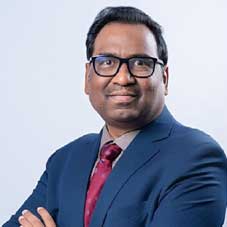
Yogesh Kanna
Vice President
As energy systems become more complex, consulting expertise is increasingly required to address renewable integration, grid modernisation, storage, digitalisation and resilient infrastructure. The changing landscape demands leaders who can look beyond individual engineering disciplines and understand how technologies, people and project requirements come together to create reliable infrastructure. Across Asia, engineering leaders are playing an increasingly influential role in this transformation. Leaders with multidisciplinary experience are becoming central to engineering consulting firms seeking to navigate new technologies while maintaining quality, delivery discipline and client confidence. One such professional is Yogesh Kanna, Vice President – Energy at DAR Engineering, whose career has evolved alongside the transformation of modern power systems.
A graduate in Electrical Engineering with a postgraduate specialization in Power Systems from the College of Engineering, Guindy, Chennai, Kanna’s interest in the field began during the 1980s. Observing how electrical appliances improved everyday life shaped his early belief that better access to energy could contribute directly to a better quality of life.
His technical interests subsequently expanded into computer programming, fuzzy logic, neural networks and the early development of artificial intelligence. Rather than moving into computer engineering, he became interested in applying computational capabilities to complex electrical networks, reinforcing his commitment to power systems.
Over the years, Kanna has built experience across nuclear, hydro and thermal power, transmission and distribution, FACTS, BESS and HVDC, alongside exposure to water, gas and steam distribution. This multidisciplinary journey has given him a broader understanding of interconnected infrastructure and continues to shape his technical and leadership approach at DAR Engineering.
Yogesh Kanna drives energy transformation by combining
multidisciplinary engineering expertise, innovation, and leadership to build resilient infrastructure
How has your multidisciplinary experience shaped the way you lead complex engineering assignments and create value for clients?
My experience across technical assignments, multidisciplinary projects, client engagement and people management has taught me that technical expertise is only the starting point. Leadership requires understanding where technologies are heading, anticipating client needs and building the right organisational capabilities. I believe technical dependability is non-negotiable, but engineers must also move from focusing on 'my work' to taking ownership of 'our project. My role as a leader is to set the direction, establish the right conditions for the team to perform, and give people the space and support to contribute their strengths and take ownership. Complex projects succeed when engineering, quality, project controls and business functions work together towards a common objective.
How is DAR Engineering preparing its Energy business for Saudi Arabia’s evolving power infrastructure requirements?
I see the power system moving from conventional, centrally generated electricity towards an increasingly renewable, distributed, digital and power-electronics-driven model. This transition makes grid planning, transmission expansion, stability studies and advanced controls increasingly important. Energy storage will support not only energy shifting but also frequency regulation, voltage support, renewable firming, black start and system resilience. Technologies such as HVDC, FACTS, STATCOMs and grid-forming inverters will also become more significant. At DAR, our focus is on developing capabilities across these areas while building engineers who understand how individual technologies interact with the wider power system.
What are the key considerations when integrating utility-scale battery storage with renewable generation and the grid?
I believe battery storage must be considered an integral part of the wider power system rather than simply a standalone energy source. Its value extends from energy shifting to frequency regulation, voltage support, renewable firming, black-start capability and grid resilience. Successful integration requires detailed power-system studies and a clear understanding of how storage interacts with transmission networks, power electronics, control systems and grid stability. Technologies such as FACTS, STATCOMs, HVDC and grid-forming inverters must also be considered within this broader framework. Equally important is developing multidisciplinary teams spanning power systems, automation, communications, controls, software and data.
Which developments will have the greatest impact on Middle Eastern energy engineering in the coming years?
I believe the biggest change will come from the transformation of the overall power system rather than any single technology. Renewable integration, grid-scale storage, HVDC, FACTS, STATCOMs, synchronous generators, and grid-forming inverters will reshape how networks are planned and operated. This will form the foundation to connect KSA Grid across the regions enabling it to export Energy without shipping routes. Digital substations, automation, wide-area monitoring, digital twins, intelligent analytics and AI will further transform infrastructure across its lifecycle. However, technology alone will not determine success. engineering leaders should empower engineers who can connect disciplines across power systems, automation, controls, communications, software and data to solve increasingly complex problems for which standard solutions may not yet exist.
What is your long-term vision for DAR Engineering’s Energy business and your contribution to Saudi Arabia’s energy transformation?
Having worked in Saudi Arabia and with DAR Engineering for around two and a half decades, I see my contribution extending beyond individual projects to developing the people who will deliver the next generation of infrastructure. A major priority is nurturing young Saudi engineers into technically capable professionals, technocrats and future leaders. I want them to gain structured learning, challenging project exposure, and progressively greater responsibility while developing independent thinking. My long-term aspiration is to help create Saudi technical leaders who can shape the Kingdom’s future energy infrastructure, while strengthening DAR as a technically capable, and locally empowered partner in this transformation. I would consider that a meaningful contribution to both DAR and Saudi Arabia.
Yogesh Kanna, Vice President – Energy, DAR Engineering
Yogesh Kanna is Vice President – Energy at DAR Engineering, bringing nearly three decades of experience across power and energy infrastructure. An Electrical Engineering graduate with a postgraduate specialization in Power Systems, he has expertise spanning nuclear, hydro and thermal power, transmission and distribution, FACTS, BESS and HVDC. He has spent around 26 years working in Saudi Arabia.