


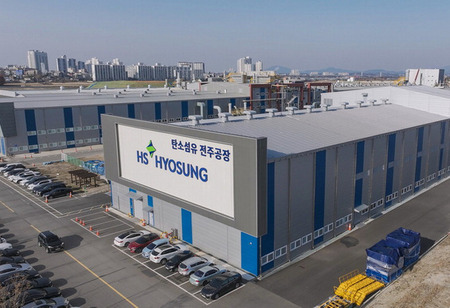
Hyosung Heavy Industries has increased its production capacity for high-voltage circuit breakers by opening a new plant in Changwon, South Korea, which is dedicated to exports, enabling it to take advantage of the growing global demand for power grid equipment fueled by artificial intelligence (AI) data centers and modernization of the grid.
The company revealed on October 17 that it finished building the facility on October 16 after investing around KRW 100 billion. Situated at its Changwon facility in South Gyeongsang Province, the new plant spans around 18,996 square meters and has commenced commercial operations.
Also Read: Saudi Arabia Inks Energy Deals With IEF, Others
Approximately 300 individuals were present at the opening ceremony, which included Hyosung Vice Chairman Lee Sang-woon, lawmakers Heo Seong-moo and Kim Jong-yang, as well as Korea Electrotechnology Research Institute President Kang Sang-hee.
The new facility signifies a move to a dual production model, where the current plant will concentrate on domestic products and the new factory will specialize in export-oriented circuit breakers rated at 420kV, 550kV, and 800kV. The expansion enhances Hyosung Heavy Industries' production capability for circuit breakers rated at 420kV and higher at its Changwon facility.
The facility combines component production, assembly, testing, and shipping in a single location, optimizing manufacturing and enhancing the firm's capacity to fulfill delivery timelines for significant international orders.
Production capability for insulating elements, essential for high-voltage circuit breakers, has similarly increased twofold, enhancing supply chain reliability through internal production.
The funding arrives as electrical infrastructure has turned into a crucial hurdle for the swift growth of AI computing. Extensive data centers necessitate dependable power sources, leading utility companies to invest in transmission networks, substations, and various electrical infrastructure. Simultaneously, aging electrical grids in key markets are generating an increased need for high-voltage equipment.
Also Read: OnMeta Boosts Global Footprint With Kazpost Partnership
Hyosung Heavy Industries is experiencing robust order growth. At the end of the second quarter of 2026, its heavy industries segment reported a consolidated order backlog of KRW 17.507 trillion. By the end of 2025, the backlog for power equipment alone had surpassed KRW 12 trillion, creating a significant pipeline of projects for the company to execute.
North America has become a crucial market for growth. In June 2025, Hyosung Heavy Industries entered into an agreement valued at around KRW 260 billion to provide high-voltage circuit breakers to a utility company in the U.S. In early 2026, it obtained an additional contract for power equipment supply valued at around KRW 787 billion with a U.S. transmission grid operator.
The firm is additionally broadening its international production presence. In June 2026, it formed a partnership with U.S. infrastructure solutions company Quanta to create a local manufacturing facility for ultra-high-voltage circuit breakers, signifying a new phase in its North American localization approach.
Also Read: Saudi Minister Stresses Global Energy Security at WPC Congress
Hyosung Heavy Industries has poured a total of $300 million into its power transformer facility located in Memphis, Tennessee. Once the current expansion is finished, the facility is anticipated to be one of the largest transformer manufacturing operations in the US. In Europe, the firm is enhancing collaboration with regional power technology organizations through its European R&D center based in the Netherlands. It intends to grow its market presence with eco-friendly products and personalized solutions designed for local needs.
Hyosung Heavy Industries started the development of gas circuit breakers in 1978, initiating with a model rated at 170kV. In 2024, it emerged as the initial company in South Korea's sector to exceed KRW 10 trillion in total circuit breaker manufacturing.