


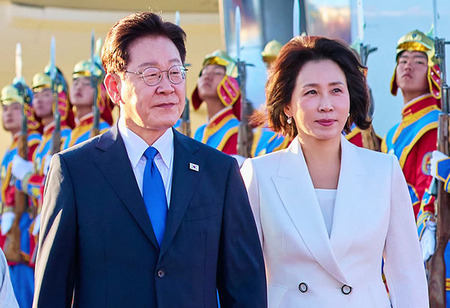
The leaders of South Korea and Mongolia reached an agreement to enhance collaboration on essential minerals to establish a strong and complementary alliance in trade and supply chains during their summit in Ulaanbaatar.
President Lee Jae Myung discussed with Mongolian President Khurelsukh Ukhnaa how to enhance peace and prosperity on the Korean Peninsula by utilizing Mongolia's long-standing amicable relations with North Korea.
The bilateral summit occurred on the initial day of Lee’s three-day official visit to Mongolia — the first by a Korean leader in 15 years and just one year following Lee's inauguration in June 2025.
Also Read: Prabowo Backs IIM, IIT Campuses for Indonesia-India Education
Cheong Wa Dae stated that the timing demonstrated how both nations see one another as key partners in expanding their diplomatic perspectives, with Seoul's “pragmatic diplomacy” complementing Ulaanbaatar's “Third Neighbor Policy.”
The essential minerals were prominent on the agenda, as resource-abundant Mongolia presents Korea a chance to diversify and enhance its supply chains in light of increased threats from unstable global networks.
Lee and Khurelsukh also concurred on expanding practical collaboration in various fields of mutual interest, encompassing infrastructure, food security, health care, science and technology, and environmental issues like yellow dust. The accord is based on years of collaboration in transportation, oil, and other fields since the two nations formed diplomatic ties in 1990.
The two nations will collaborate to boost bilateral trade to $1 billion by 2030, with their foundational agreement on CEPA acting as an essential move toward achieving that target. Lee and Khurelsukh investigated methods to enhance reciprocal visits and strengthen people-to-people interactions, as enthusiasm for K-culture rises in Mongolia and the nation seeks South Korea's example in swift industrialization and democratization as a model for development.
Also Read: Baemin and Seoul to Tackle Loneliness through Food Campaign
Cheong Wa Dae characterized Mongolia’s stance as “unique” on the Korean Peninsula, highlighting that it was the second nation after the Soviet Union to forge diplomatic relations with North Korea during the Cold War and has continually backed South Korea’s initiatives to foster peace on the peninsula.
Lee expressed gratitude to Khurelsukh “for reiterating his unwavering support for our government's initiatives aimed at denuclearizing the Korean Peninsula and establishing enduring peace.”
The summit was set to be followed by the signing of MOUs (memorandums of understanding).
The 21 MOUs encompassed a wide range of cooperation areas, such as improved consular cooperation, the establishment of Mongolia's second national cancer center, the exchange of expertise for the new administrative capital, green energy initiatives, forest restoration to address desertification, and advancements in digital banking innovation.
Also Read: Vietnam's Coffee Export Value Hits 4.78 Billion USD in H1
They also addressed the management of the memorial park dedicated to Korean independence leader Lee Tae-jun (1883-1921), broadened cultural collaboration to encompass creative sectors like OTT platforms, gaming, and webtoons, recognized each other’s driver's licenses, and focused on safeguarding cultural and natural heritage.
On Friday, Lee will attend the memorial dedicated to Lee Tae-jun, followed by a luncheon meeting with the Korean community members in Mongolia.
On Saturday, Lee and Khurelsukh will be guests of honor at the Naadam opening ceremony, a traditional festival. The festival, the biggest national celebration in Mongolia, honors the nation's essence of freedom and independence. Lee will be the inaugural South Korean president to receive an invitation as a guest of honor.