


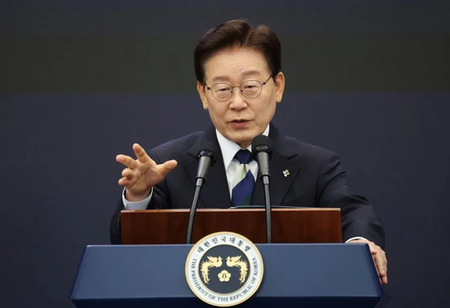
President Lee Jae Myung promised significant investment in artificial intelligence (AI) and other emerging industries to enhance South Korea's economic growth capacity and guarantee what he termed "growth for all."
“We will invest 21.3 trillion won (US$15.97 billion), nearly twice this year’s amount, in AI and the three megaprojects of semiconductors, physical AI and AI data centres,” Lee says.
Also Read: Three State Firms Join to Drive Indonesia's E-Motorcycle Program
In September, his administration suggested raising government expenditure by an unprecedented 12.8 percent next year to 820.9 trillion won (US$615.62 billion), with the goal of enhancing South Korea’s technological advantage as global competition in AI escalates.
The demand for advanced AI chips has significantly strengthened South Korea's economy, increasing exports and the profits of memory chip manufacturers Samsung Electronics and SK Hynix.
Asia's fourth-biggest economy experienced growth that surpassed expectations in the third quarter due to chip exports and investment. Between January and October, exports amounted to US$930 billion, poised to surpass US$1 trillion this year, positioning South Korea as the fourth nation globally to achieve this landmark after the US, China, and Germany.
Also Read: Samsung, Gas Safety Agency Team Up to Protect Chip Operations
Lee stated that achieving annual exports of US$1 trillion is now possible, but cautioned that the advantages are not evenly distributed.
“We must make a great transition from ‘growth for the few,’ in which opportunities and gains are concentrated among certain regions, classes and a small number of companies, to ‘growth for all,’” he says.
“Fiscal foundation is also becoming stronger,” Lee says, noting that next year’s fiscal deficit will narrow to 0.1 percent of gross domestic product, the lowest in two decades, from 3.9 per cent this year, with the debt-to-GDP ratio down to 48.3 per cent from 51.6 percent.
Lee added that international organizations and major credit rating agencies viewed such improvements and the concept of a Future Response Fund “very positively.”
The financial plan allocates 162.3 trillion won to a Future Response Fund, primarily supported by increased tax income from the semiconductor surge, aimed at fostering growth sectors, aiding youth, promoting regional development, and enhancing education, while also serving as a safeguard against potential revenue declines.
Lee is concurrently engaged in large-scale national projects focused on semiconductors, physical AI, and data centers, featuring an 800 trillion won private chip expansion spearheaded by Samsung and SK Hynix in the southwestern region of the country.
Kim Jin-wook, an economist at Citi, mentioned that there are positive elements for credit ratings agency Fitch, which currently assesses South Korea one level below Moody’s and S&P, that could lead to an upgrade of South Korea’s credit ratings from the existing “AA-“ to “AA” in the years ahead.
Also Read: RTA, Dubai Holding Construct Palm Jumeirah Pedestrian Bridges
“We see the cumulative funding source for the Future Response Fund reaching up to KRW215trn for 2026–2027,” Kim says, expecting it to raise both potential economic growth and fiscal sustainability.