

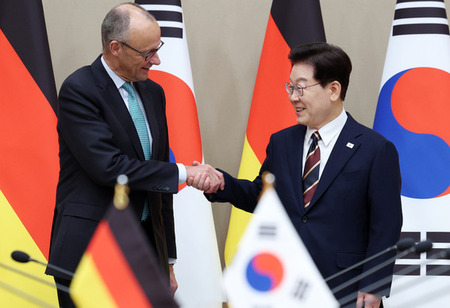
President Lee Jae Myung and German Chancellor Friedrich Merz reached an agreement to upgrade their bilateral relations to an “enhanced strategic partnership,” formalizing multiple agreements across defense, technology, energy, and trade during Merz’s official visit to Seoul.
“Building on this deep trust and cooperation, Chancellor Merz and I have agreed to establish an ‘enhanced strategic partnership’ between the two countries,” Lee said at Cheong Wa Dae.
“Germany is the Republic of Korea’s largest trading partner in Europe ... The joint statement adopted today reflects our firm and clear commitment to deepening cooperation across a wide range of areas, including politics, security, the economy, culture and people-to-people exchanges, while strengthening future-oriented cooperation and strategic coordination.”
Also Read: Nama Electricity Distribution Eyes Investment in Oman
Among the signed agreements, the two nations established a Joint Declaration of Intent regarding a Framework for an Economic and High-tech Partnership, designed to enhance bilateral collaboration in trade, industry, and emerging technologies—covering the automotive sector, batteries, industrial artificial intelligence (AI), smart manufacturing, advanced energy systems, and robotics.
They also endorsed the Protocol Amending the Korea-Germany Double Taxation Avoidance Agreement, executing treaty-related actions under the OECD-G20 initiative on base erosion and profit shifting. Seoul and Berlin also reiterated their dedication to enhancing and updating their Energy Partnership in accordance with common decarbonization objectives and changing energy requirements.
In defense, both parties committed to enhancing industrial collaboration and moving forward with an agreement to share classified military information and carry out joint military exercises.
Also Read: Sonowal to Pitch India's Maritime Opportunity to Korean Industry
"Building on both countries’ advanced defense technologies and industrial capabilities, we will actively explore opportunities for mutually beneficial cooperation between our defense companies," Lee said, noting Korean defense firms' "keen interest in forming long-term partnerships, including joint ventures and joint development projects" with Germany, the world’s third-largest economy and Europe’s largest.
This marks Merz's initial trip to Korea since assuming his role and the first bilateral visit from a German chancellor in the last three years. The two leaders convened approximately four months following their discussions during the G7 summit in France last June.
Merz highlighted North Korean soldiers engaged in the Russia-Ukraine conflict and cautioned that Moscow might provide sophisticated military equipment to Pyongyang in exchange, claiming that the circumstances in Ukraine are closely tied to security in Korea and Europe.
“Korea’s security is directly linked to Europe’s security and European security is equally intertwined with Korea’s,” Merz said.
Also Read: ADNOC Unveils $16 Billion in Local Manufacturing Opportunities
“If North Korean soldiers from Pyongyang fight in the Donbas region against Ukrainian forces, European freedom itself is put at risk. Furthermore, if Moscow supplies advanced military assets or weaponry to Pyongyang in return, the repercussions will extend far beyond Europe.”
He added, “We all share a common goal: an end to war accompanied by a just and lasting peace — and a Europe living in that peace.”
The state dinner that followed the summit was attended by over 60 business leaders from both nations. Korean participants comprised Korea International Trade Association Chairman Yoon Jin-sik, Hyundai Motor Group Executive Chair Chung Euisun, POSCO Group Chairman Chang In-hwa, Hyosung Group Chairman Cho Hyun-joon, and HL Group Chairman Chung Mong-won.
The German delegation featured Siemens CEO Roland Busch, who leads the Asia-Pacific Committee of German Business, Diehl Defence owner Markus Diehl, and Mahle CEO Arnd Franz.