


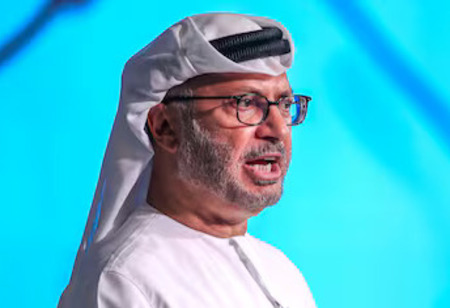
Anwar Gargash, a representative from the United Arab Emirates, emphasized the importance of ensuring access through the Strait of Hormuz in any resolution to the conflict between the US and Iran.
He cautioned that an agreement lacking provisions to control Iran's nuclear activities, as well as its development of missiles and drones, could potentially lead to a Middle East that is even more perilous and unstable.
Also Read: Lee, Macron Hold Summit as Seoul Eyes Upgrade in Bilateral Ties
Gargash, the diplomatic adviser to the president of the UAE, stated during a weekend briefing that the Strait of Hormuz, widely regarded as the most vital oil passage globally, should not be militarized. He emphasized that the security of this waterway is not merely a local negotiating tool, but a crucial necessity for the global economy.
"The Strait of Hormuz cannot be held hostage by any country," said Gargash, adding that freedom of navigation through the waterway "has to be part and parcel of the settlement of any conflict with clear agreement on that”.
Gargash expressed the UAE's desire for the conflict to come to a conclusion, while cautioning against a cessation of hostilities that fails to address the underlying factors contributing to instability.
“We don’t want to see more and more escalation,” he says. “But we don’t want a ceasefire that fails to address some of the main issues that will create a much more dangerous environment in the region...notably (Iran's) nuclear program, the missiles and drones that are still raining down on us and on other countries”.
US President Donald Trump issued a stern warning to Tehran, stating that severe consequences would be imposed if a deal was not reached to reopen the Strait of Hormuz by the specified deadline. Through a communication on his Truth Social platform over the weekend, Trump made explicit threats of additional strikes on Iranian energy and transportation facilities that have been deemed by some as potential violations of international law.
Also Read: Dubai Launches AED 1 Billion Incentives, Others for Economy
Gargash expressed the willingness of the United Arab Emirates to participate in any multinational initiative under US leadership aimed at ensuring the protection of maritime traffic in the strait.
Gargash stated that Iran's tactics are likely to strengthen the alliance between the Gulf region and Washington in terms of security, rather than weaken it. This is expected to solidify the presence of the US military in the area and increase Israel's influence. He emphasized that the US will continue to be the UAE's primary security ally, and Abu Dhabi will further invest in this partnership as the threats in the region escalate.
Iran's attacks on energy facilities and transportation routes in the Gulf region were perceived by officials in the area as a deliberate effort to amplify the financial burdens of Washington's allies in the Gulf. By targeting oil facilities, ports, and crucial waterways such as the Strait of Hormuz, Iran aimed to compel Gulf states, worried about economic disruption and broader regional ramifications, to urge the United States to cease its actions.
Also Read: KT Appoints Park Yoon-young New CEO, Eyes AI-driven Reshuffle
The rationale behind this approach was informed by a longstanding strategy within the Gulf region of carefully managing relationships with both Washington and Tehran, seeking to mitigate tensions and prevent direct conflicts. Gargash asserted that the leadership of Iran is focused on preserving the regime rather than the nation itself, suggesting that a rational government would not willingly endure such devastation in order to assert its resistance.
He emphasized that the United Arab Emirates does not intend to provoke animosity with Iran; however, he cautioned that fostering trust is unattainable given the current administration in Tehran. He expressed gratitude on behalf of the UAE for the assistance it has received from the international community, specifically recognizing France as a reliable ally and commending Washington for its exceptional support, especially in enhancing the UAE's air defense capabilities.