


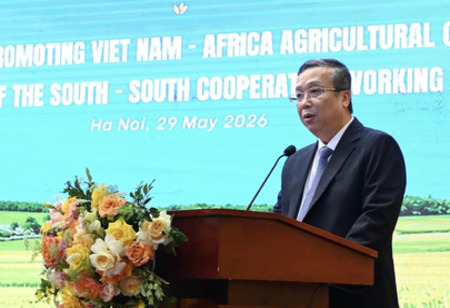
Pham Ngoc Mau, Deputy Director of the Department of International Cooperation at the Ministry of Agriculture and Environment, stated that agriculture could be a leading sector in enhancing Vietnam–Africa collaboration and facilitating the entry of Vietnamese companies into African markets across various economic sectors.
He delivered the comments during a workshop aimed at enhancing private sector collaboration in agriculture between Vietnam and Africa, which took place in Can Tho city on November 23. The event occurred as part of the Carbon Offsetting Rice Emission Reduction (CORE) initiative, supported by Germany's Federal Ministry for Economic Cooperation and Development (BMZ).
Also Read: Votee AI, AI Singapore Join Hands to Advance Southeast Asian AI
Mau, who leads the working group on South–South Cooperation in agriculture, stated that Africa has significant potential in land, natural resources, workforce, and market size, with numerous countries in the region emphasizing agricultural growth, food security, and attracting foreign investment. On the other hand, Vietnam has built a wealth of agricultural knowledge, technological skills, and increasing business capacity.
He emphasized the importance of advancing from merely sharing experiences and transferring technology to establishing thorough partnerships that connect science and technology with investments, production, processing, and market development, allowing businesses from both parties to collaboratively create value chains based on equality and mutual advantage.
He emphasized that businesses are the key players in fostering sustainable South–South Cooperation, while state institutions, research organizations, and international development entities offer connections and institutional backing.
Pham Ngoc Mau, Deputy Director of the Department of International Cooperation at the Ministry of Agriculture and Environment, remarked that agriculture could play a pivotal role in boosting Vietnam–Africa collaboration and aiding Vietnamese businesses in entering African markets in diverse economic sectors.
Also Read: Braskem and Toyota Tsusho Expand Bio-Based PE Packaging in Japan
He made the remarks during a workshop focused on improving private sector cooperation in agriculture between Vietnam and Africa, held in Can Tho city on November 23. The occurrence was part of the Carbon Offsetting Rice Emission Reduction (CORE) initiative, backed by Germany’s Federal Ministry for Economic Cooperation and Development (BMZ).
Mau, head of the South–South Cooperation working group in agriculture, noted that Africa possesses considerable potential in terms of land, natural resources, labor force, and market size, with many countries in the area prioritizing agricultural development, food security, and the attraction of foreign investment. In the interim, Vietnam has developed a rich base of agricultural expertise, technical abilities, and growing business potential.
He stressed the significance of progressing beyond just sharing experiences and transferring technology to forming comprehensive partnerships that link science and technology with investments, production, processing, and market development, enabling companies from both sides to jointly develop value chains rooted in equality and shared benefits. He stressed that companies are essential in promoting sustainable South–South Cooperation, while government entities, research institutions, and global development organizations provide support and institutional connections.
Also Read: GS25 Enters Cambodia, Targets 500 Stores Within the Next 10 Years
Oemar Idoe, Deputy Country Director of the German Agency for International Cooperation (GIZ) in Vietnam, commended Vietnam's expertise in enhancing rice yield, coordinating farmers, and advancing sustainable agriculture. He stated that climate change, diminishing natural resources, and pressures on food security are common challenges that necessitate collaborative efforts and mutual learning. South–South Cooperation can aid nations in exchanging effective models and tailoring them to their specific contexts.