


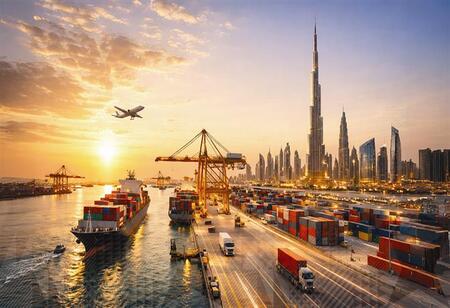
As the UAE expands its global economic reach through strategic trade agreements, governments and businesses are gaining new opportunities in transportation, energy, aviation, and maritime logistics. Partnerships with Saudi Arabia, Germany, Azerbaijan, India, and Japan reflect the country’s efforts to diversify its economy, strengthen international supply chains, and deepen access to key global markets. This article highlights five major trade deals, exploring their potential impact on cross-border connectivity, energy security, industrial development, and international investment, while highlighting how the UAE is leveraging its geographic position and commercial partnerships to reinforce its role in the evolving global economy.
The United Arab Emirates (UAE) is strengthening its position as a global trade and investment hub, supported by record growth in international commerce and an expanding network of strategic partnerships.
According to the Dubai Government Media Office, the UAE’s non-oil foreign trade surpassed AED 3.8 trillion (approximately $1.03 trillion) in 2025, registering growth of around 27percent compared with 2024. Non-oil exports reached AED 813.8 billion, increasing by 45.5percent and highlighting the country’s progress towards economic diversification.
In light of this, five major agreements with Saudi Arabia, Germany, Azerbaijan, India and Japan demonstrate the UAE’s ambition to expand its global economic reach. The partnerships cover rail connectivity and energy cooperation, aviation and investment, maritime logistics, ship repair and skills development, as well as energy trading and shipping.
Together, these initiatives reflect the UAE’s strategy of diversifying trade relationships, strengthening global supply chains and building long-term economic partnerships across key international markets.
1. UAE and Saudi Arabia Sign Rail and Energy Cooperation Agreement
The agreement between the UAE and Saudi Arabia represents an important step towards strengthening economic integration between the two largest economies in the Gulf. Announced on October 8, 2026, the preliminary agreement establishes a framework for developing rail connections and expanding energy cooperation, with the objective of improving cross-border trade, transportation efficiency and regional connectivity.
A central element of the agreement is the proposed development of rail links between the two countries. The governments intend to undertake technical and economic feasibility studies to assess how their railway networks could be connected and how freight transportation could be improved.
An effective cross-border rail system could provide businesses with another option for moving goods between the UAE and Saudi Arabia. Rail freight can complement road transport, particularly for large volumes of industrial materials, manufactured products and other commodities moving over long distances.
For companies operating across the Gulf, improved railway connectivity could help create more predictable supply chains. Better integration of freight networks could also support the movement of goods between industrial zones, distribution centres, ports and commercial markets.
Beyond transportation, the agreement covers electricity interconnection and the exchange and sale of power between the UAE and Saudi Arabia. Both countries will examine technical, economic and environmental considerations, while coordinating with other Gulf Cooperation Council (GCC) members on the wider regional electricity network.
Closer electricity cooperation could help improve the use of available generation capacity, strengthen grid resilience and provide additional flexibility in balancing supply and demand. Interconnected systems can create opportunities for electricity exchanges when one market has surplus capacity and another faces greater demand, subject to technical constraints and commercial arrangements.
The wider regional implications are equally important. As Gulf economies expand their industrial bases, digital infrastructure and energy-intensive industries, reliable electricity supplies become increasingly important for economic competitiveness.
Also Read: From China+1 to China+Many: How Asian Companies Are Redesigning Supply Chains
2. UAE and Germany Sign Air Transport Agreement and Expand Cooperation
The UAE's expanded partnership with Germany illustrates its efforts to deepen commercial relationships with one of Europe's leading industrial economies. During UAE President Sheikh Mohamed bin Zayed Al Nahyan's state visit to Germany in September 2026, the two countries announced a series of agreements, memoranda of understanding and declarations covering aviation, investment, energy, technology, environmental cooperation and other strategic areas.
One of the key announcements concerned air transport arrangements and access rights for UAE national carriers at Berlin Airport. The countries also announced cooperation intended to facilitate passenger procedures.
For the UAE, aviation is closely connected to its role as an international business, tourism and logistics hub. Air links help connect companies to overseas markets, enable business travel and support the movement of time-sensitive cargo. Improved access arrangements can create opportunities for airlines to strengthen their networks, although the actual commercial impact will depend on the implementation of the agreed provisions and airlines' operational decisions.
Germany is an important European market for business travel, tourism, manufacturing and investment. Stronger air transport cooperation can make it easier for executives, investors, technical specialists and other travellers to move between the two economies.
Aviation is only one part of the wider UAE-Germany relationship. The September announcements included plans to establish a UAE-German Investment Council and launch a Strategic Dialogue. Other areas covered energy cooperation, data-centre investment in Germany, data hosting, environmental protection and cultural relations.
The proposed Investment Council could provide a platform for identifying opportunities, encouraging business-to-business cooperation and improving engagement between public authorities and private investors. Meanwhile, the Strategic Dialogue establishes a framework for addressing a wider range of shared priorities.
Technology and digital infrastructure are particularly relevant as both economies seek to benefit from digitalization, artificial intelligence and growing demand for computing capacity. Cooperation involving data centers and information systems could open opportunities for investment, technical partnerships and the development of supporting infrastructure.
The broader economic relationship also received a boost from the September business program. ARN News Centre reported that a UAE investment package worth €40 billion in Germany was announced during the visit, alongside a series of commercial agreements and memoranda.
For the UAE, Germany offers access to industrial expertise, advanced engineering, technology and European commercial networks. For German businesses, the UAE provides a base for reaching markets across the Middle East, Africa and Asia.
3. AD Ports Group Signs Logistics and Maritime Cooperation MoU with Azerbaijan
The agreement between AD Ports Group and Azerbaijan Transport and Communications Holding (AZCON Holding) highlights the UAE's ambition to expand its logistics footprint beyond the Gulf. Announced in April 2026, the memorandum of understanding establishes a framework for exploring collaboration in ports, shipping, logistics, digital trade and integrated transport infrastructure in Azerbaijan.
A major opportunity associated with the agreement is the development of transport and logistics connections along the Middle Corridor, a trade route that links parts of Asia with Europe through the Caspian Sea region and the South Caucasus.
As businesses and governments seek to diversify international supply chains, alternative transport corridors have attracted greater attention. The effectiveness of these routes depends on several factors, including port capacity, rail connections, border procedures, digital documentation, transit times and the coordination of logistics operators across different countries.
AD Ports Group's experience in ports, maritime services, logistics and digital solutions could support efforts to address some of these requirements. Its collaboration with AZCON Holding creates a basis for evaluating potential investments and integrated infrastructure projects in Azerbaijan.
4. UAE and India Sign Ship Repair and Maritime Skills Development Agreements
The UAE's maritime partnership with India is an example of how international cooperation can generate industrial opportunities beyond conventional shipping and cargo transportation. During Indian Prime Minister Narendra Modi's visit to the UAE in May 2026, the two countries announced agreements involving Cochin Shipyard Limited (CSL), Dubai-based Drydocks World and India's Centre of Excellence in Maritime & Shipbuilding (CEMS). The agreements focused on establishing a ship repair cluster at Vadinar, Gujarat, and developing specialized skills in ship repair.
These initiatives connect the UAE's established maritime services expertise with India's industrial capabilities and expanding maritime infrastructure.
Ship repair is an essential component of the global maritime economy. Commercial vessels require regular maintenance, inspections, repairs and technical upgrades to remain operational and meet safety requirements. Reliable repair facilities help shipowners manage maintenance schedules, minimize downtime and maintain the efficiency of their fleets.
The proposed ship repair cluster at Vadinar aims to strengthen India's capacity to provide these services. By bringing together Cochin Shipyard's shipbuilding and engineering experience with Drydocks World's international expertise, the partnership could help develop a more competitive maritime services ecosystem.
For the UAE, the agreement creates opportunities to extend the capabilities of its maritime companies into another major shipping market. Drydocks World's experience in vessel repair, maintenance and associated engineering services can complement India's existing industrial infrastructure and skilled workforce.
For India, the collaboration supports efforts to expand domestic ship repair capabilities, attract investment and develop infrastructure that can serve both national and international customers. A stronger ship repair sector could also support related industries, including fabrication, engineering, marine equipment supply and technical services.
The second agreement, involving CSL, Drydocks World and CEMS, focuses on skill development in ship repair. This component is particularly important because specialised maritime facilities depend on a workforce trained in engineering, vessel maintenance, safety procedures and modern repair techniques.
Training and knowledge sharing can help workers acquire the technical competencies needed to support more advanced repair operations. Cooperation between established industry participants and training institutions could also help align education with the practical requirements of employers.
The agreement also illustrates the importance of combining infrastructure investment with workforce development. New facilities alone cannot guarantee competitiveness; their success depends on the availability of qualified personnel, effective management systems, modern equipment and consistent quality standards.
The May announcements were followed by a further development in September 2026, when Drydocks World and Cochin Shipyard signed a 50:50 joint venture agreement to operate and expand the International Ship Repair Facility in Cochin. The agreement builds on their earlier cooperation and aims to increase capacity for Indian, regional and international customers.
This progression from an initial cooperation framework towards a formal joint venture demonstrates how bilateral agreements can evolve into more concrete industrial partnerships.
Also Read: South Korea's Viral Bakery Boom: Why Bread Has Become a Lifestyle
5. ADNOC and XRG Sign Energy and Shipping Cooperation Deal with Japan's Mitsui
The partnership involving Abu Dhabi National Oil Company (ADNOC), its international investment platform XRG, and Japan's Mitsui & Co. demonstrates the UAE's continuing efforts to strengthen its position in global energy markets.
In July 2026, the companies announced a strategic collaboration agreement to explore opportunities across liquefied natural gas (LNG), crude oil, sulphur, shipping, chemicals and international energy investments. The agreement also includes potential cooperation in lower-carbon fuels and related industrial projects.
Unlike an agreement limited to the sale of a particular commodity, this arrangement establishes a broader framework for exploring cooperation across several interconnected parts of the energy value chain.
Japan is an important market for international energy suppliers, with its industrial economy requiring reliable access to imported energy resources. Long-term commercial relationships can help connect producers, traders, shipping companies and industrial consumers, supporting the movement of energy products across international markets.
ADNOC and Mitsui have an established relationship dating back to the 1970s. The new agreement builds on that history by exploring additional opportunities in energy supply, trading, logistics and investment.
The LNG component is particularly relevant to international energy trade. LNG enables natural gas to be transported by specialized vessels to markets that may not be connected to producers by pipelines. Cooperation on LNG sales and optimization could help the companies examine ways to improve commercial arrangements and supply-chain coordination.
The agreement also covers crude oil market development and long-term supply opportunities. These activities could support closer engagement between the companies in identifying market requirements, evaluating commercial opportunities and strengthening links between producers and customers.
Sulphur procurement and logistics form another part of the framework. Sulphur is used in several industrial applications, including fertilizer production and chemical manufacturing. Coordinating its procurement and transportation can therefore support industries beyond the conventional oil and gas sector.
Shipping is central to the agreement because energy products and industrial commodities depend on specialized transportation networks. The companies will explore shipping solutions for LNG, ammonia, sulphur and other commodities.
More integrated shipping arrangements could help coordinate cargo movements with commercial supply agreements, improving the connections between production, transportation and end markets. The actual benefits will depend on the commercial structures developed and the feasibility of individual opportunities.
The involvement of XRG adds an international investment dimension. The company will explore potential overseas energy investments with Mitsui, including opportunities associated with lower-carbon growth. The agreement also identifies potential cooperation involving methanol and other projects connected to TA'ZIZ, the UAE's industrial and chemicals development platform.
This wider scope reflects the changing nature of energy-sector investment. While oil and gas remain important to global energy supply, companies are also assessing opportunities in chemicals, industrial materials and alternative fuels.
Also Read: Why the Strait of Hormuz Crisis Is Becoming Asia’s Economic Problem
Conclusion
The five agreements with Saudi Arabia, Germany, Azerbaijan, India and Japan demonstrate how the UAE is expanding its global economic reach through a combination of infrastructure cooperation, investment, industrial development and international trade partnerships.
Each agreement addresses a different commercial need, but their underlying objectives are closely connected: to improve connectivity, develop industrial capabilities, strengthen supply chains and open new markets for UAE businesses.
Their ultimate success will depend on how effectively the announced frameworks are translated into operational projects and sustainable commercial relationships. If implementation proceeds successfully, these partnerships could reinforce the UAE's position as a major international center for trade, logistics, energy and investment while supporting its long-term economic diversification.