


 Sustainability has moved from corporate ambition to operational pressure. Across Asia and globally, organisations are expected to prove – not just promise – how they manage climate and responsible sourcing risks across their supply chains.
That means stronger visibility, credible verification and better integration between climate and sourcing efforts.
Drawing on LRQA’s Climate Performance & Responsible Sourcing Risk Outlook 2026, we explore where companies are making progress and where critical gaps remain.
Supplier oversight: How deep does your gaze go?
While many companies have improved their oversight of immediate suppliers, a key challenge remains scaling that visibility and assurance across increasingly complex supply chains.
Focusing solely on key suppliers, a common practice, risks overlooking critical human rights, environmental, or ethical issues deeper within the value chain, particularly with lower-tier suppliers lacking direct contracts.
With new regulations emerging, limited coverage can lead to compliance and reputational risks. LRQA’s report shows that nearly half of companies assess only key suppliers for sustainability issues, highlighting this concentrated approach.
"The global economy is under growing scrutiny, and organisations need to make clear, defensible decisions about where to focus their efforts. The companies that will move ahead are those that can prioritise effectively, respond quickly to emerging risks and back their actions with credible evidence. We’re in a new era of integrated risk management.”
- Fotis Kampouris, LRQA APAC Executive Vice President.
Transparency: Can you afford to keep your supply chain a mystery?
Transparency is the absolute bedrock for effective risk management in responsible sourcing. Without a comprehensive view into every facet of the supply chain - from supplier locations to material flows - organisations cannot reliability assess risks such as labour conditions or environmental impact.
Investing in this clarity helps pinpoint and prioritise risks, and it underpins more trustworthy reporting. LRQA data shows that over a third of organisations naming supply chain transparency and traceability as their top priority.
Verification: Are your checks still stuck in the past?
Despite the crucial role of supplier verification, there is a concerning reliance on older, traditional methods, such as self-assessments. These approaches are resource-intensive, struggle to scale across fragmented supply chains and often provide only a point-in-time view.
Modernising verification by blending digital intelligence with targeted certifications can improve prioritisation and resource allocation. LRQA’s report indicates that most companies still rely on self-assessments or audits, while digital risk mapping remains underutilised.
A key finding from another industry survey, EiQ -Top Trends in Responsible Sourcing 2026, underscores AI as the critical investment for responsible sourcing, signalling a growing recognition only relying on static questionnaires and manual efforts are inadequate for today's dynamic risk landscape.
The power of connection: Why aren’t your climate and sourcing efforts talking?
An important finding from LRQA’s report is the challenge of integrating climate performance and responsible sourcing efforts. Their boundaries are blurring, yet internal structures often lag. Without integrated governance, we see duplicated efforts, inconsistent information and confusing messages for suppliers.
This fragmentation is particularly evident in how suppliers feed into climate goals, representing a significant missed opportunity. Climate strategies can easily fall apart if they do not extend beyond a company's immediate operations.
The LRQA survey reveals that less than a quarter of companies have fully aligned their climate and responsible sourcing teams, and nearly half report minimal or no supplier involvement in climate programmes.
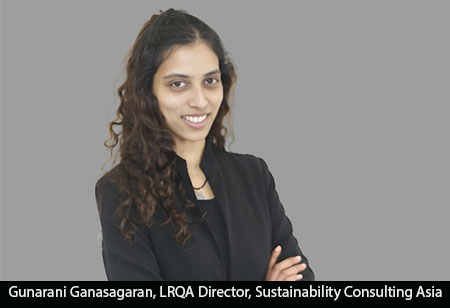
"The true test of an organisation's commitment to sustainability isn't just in its policies, but in its ability to seamlessly weave climate performance and responsible sourcing into the very fabric of its supply chain operations. This integration is a fundamental requirement for long-term resilience and competitive advantage."
- Gunarani Ganasagaran, LRQA Director, Sustainability Consulting Asia.
One size fits all? Not in this game.
A one-size-fits-all approach to risk management simply does not work. Risks appear differently across various sectors, shaped by unique industry characteristics. Food and beverage companies, for example, show advanced supplier involvement in climate goals due to reliance on climate-sensitive raw materials, while the energy sector demonstrates more established management alignment.
Each sector faces distinct pressures, underlining the need for customised strategies. Furthermore, within the diverse Asia-Pacific region, strategies must also account for varying regulatory landscapes, including the impact of complex export-related regulations, economic development stages, cultural contexts, and the associated operational costs.
What is your blueprint for the future?
The biggest risks in 2026 stem not from a lack of good intentions, but from gaps between aspirations and execution, particularly in data, supplier oversight, cross-functional alignment and credible assurance. Regulators, customers and investors are noticing.
The way forward is not about eliminating every risk, but about smart prioritisation. Organisations must weigh the cost of action against inaction while factoring in geopolitical uncertainty and shifting global trade dynamics.
Strengthening governance, improving measurement and engaging suppliers more effectively are critical, with external partners often helping provide assurance, certification and specialist expertise.
The shift from commitment to credibility is already underway. Organisations that act with focus, agility and evidence will be better placed to build resilience and maintain a competitive edge for businesses across Asia and globally.