


The operating room already has robots. What it doesn't have is robots that understand what they're touching.
For decades, artificial intelligence advanced almost entirely in the digital world. It could process vast datasets, recognize faces, beat grandmasters at chess. What it couldn't do was act in the physical world with any real autonomy. Researchers call this the embodiment gap. For surgery, it has been the defining constraint, and it's finally beginning to close.
Precision Was Never the Problem
The first generation of surgical robotics was built around a straightforward premise: make the instrument more precise than the human hand. It worked.
Robotic arms can now operate with sub-millimeter accuracy, holding trajectories no surgeon could maintain unaided. The hardware problem is largely solved.
But precision without understanding is a different kind of danger. A highly accurate robotic arm without situational awareness not only underperforms but can amplify errors at scale.
If the system doesn't know what it's touching, it will execute a bad instruction perfectly. This is the intelligence gap: the difference between seeing anatomy and understanding it well enough to act safely within it. Closing that gap is the defining technical and commercial challenge of surgical robotics right now.
What Autonomous Vehicles Teach Us and Where the Analogy Breaks
The parallel with self-driving cars is instructive, though not in the way most people assume. Five years ago, full autonomy on public roads seemed imminent. It still isn't here. The bottleneck isn't processing power, but rather the infinite, unpredictable edge cases of the open road: a child chasing a ball, a flooded intersection, an ambiguous hand signal from a crossing guard.
Surgery looks more complex on the surface. Humans find driving far easier than operating on a spine. Yet the path to meaningful AI autonomy may actually be more achievable in the OR than on the highway. Unlike the open road, the operating room is bounded, instrumented, and data-rich. Its complexity is biological, not chaotic.
The critical difference is risk tolerance. Society extends a certain forgiveness to human drivers that it will never extend to an autonomous system. This asymmetry shapes everything from regulatory pathways to clinical adoption and liability frameworks.
Surgical AI needs to be reliably safe in every edge case, every time. That demands a fundamentally different architecture: not a system that reacts, but one that anticipates.
The World Model Problem
What surgical AI actually needs is what we might call a surgical world model — a continuously updated, patient-specific understanding of anatomy, instruments, and motion, built and maintained in real time throughout a procedure.
This requires inverting the traditional logic of surgical robotics. The field has been kinematics-first for too long: optimize the arm, then figure out where it's operating. The smarter approach puts anatomy at the center.
By fusing high-fidelity sensor data with real-time edge computing, a surgical platform can maintain continuous anatomical registration as the patient breathes, shifts, and responds to intervention — not just at setup, but throughout.
From that foundation, something genuinely new becomes possible: predictive guidance. A system with a reliable world model can warn a surgeon when a trajectory approaches a critical boundary before a mistake occurs, not after. That's the difference between a passive instrument and an intelligent partner.
The Moat Is Cognitive, Not Mechanical
The commercial implications follow directly from the technical ones. Hardware margins in surgical robotics are compressing. The robotic arm, once a premium differentiator, has become a commodity baseline.
Hospitals want integrated digital ecosystems, not isolated devices. The next competitive moat won't belong to the manufacturer with the most precise arm.
It will belong to whoever builds the most reliable world model, and accumulates it across thousands of real procedures. Data compounds while hardware depreciates. Over time, the control layer of surgical robotics won't be defined by mechanical engineering. It will be defined by the depth of anatomical intelligence built up through clinical experience.
That shift is already underway. The foundational decisions being made now, about architecture, data strategy, and where cognition sits in the system will determine who leads this market for the next decade.
The robots are already in the OR. The question is whether they have any idea what they're doing there. PathKeeper Surgical exists to ensure they do.
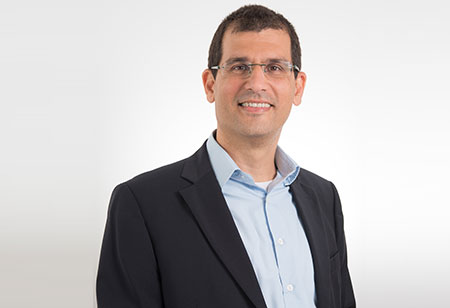
Erez Lampert is CEO and Founder of PathKeeper Surgical. The company builds AI-powered navigation for spine surgery. A 3D medical imaging expert with over 20 years of experience, Lampert previously led R&D for the Align Technology (Invisalign) Itero scanner.