



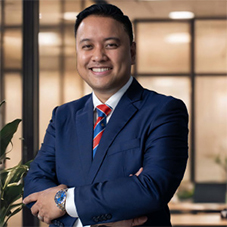
Enrique Dela Cruz
Vice President – Chief Legal Counsel
Legal leadership today extends far beyond interpreting statutes or resolving disputes. As businesses operate across jurisdictions, adopt emerging technologies, and navigate increasingly complex regulatory environments, the modern corporate counsel is expected to understand the business behind the law.
Enrique Dela Cruz’s career reflects this evolution. His journey from public service and private legal practice to corporate leadership has been shaped by a consistent belief that legal expertise creates its greatest value when it enables institutions and people to move forward with greater clarity, accountability, and confidence.
His foundation was built through two decades in public office as a Municipal Councilor and Senior Provincial Board Member, where leadership meant being accountable to communities and making decisions with long-term public impact.
His decision to waive his government salary to establish the Iskolar ni Buko Program, which supported university education for thousands of underprivileged youth, further shaped his understanding of leadership as a responsibility to empower others. This experience gave him a perspective on stewardship that continues to influence his professional approach.
A Chevening Scholarship at London Metropolitan University and University College London broadened that foundation, exposing him to international trade and comparative business law and expanding his perspective beyond local legal practice. He subsequently brought this international outlook into private practice as Senior Partner at DivinaLaw, where he developed expertise in emerging areas including FinTech, Data Privacy, and International Arbitration. The experience placed him at the intersection of law, technology, and increasingly sophisticated commercial transactions.
My vision is to build a world-class legal Center of Excellence that supports sustainable growth while strengthening institutional governance
His leadership journey took another significant turn in 2025 with the founding of the Baliuag University College of Law, providing an opportunity to build institutional governance from the ground up. These experiences have converged into a leadership philosophy that combines legal rigor with commercial pragmatism, public accountability, and a human-centric approach.
Today, as Vice President – Chief Legal Counsel at SM Prime Holdings, Dela Cruz brings this breadth of experience to one of the region’s most complex corporate environments. His career reflects the changing role of corporate counsel—from a function focused primarily on legal protection to a strategic leadership role that helps organizations understand complexity, manage risk, uphold governance, and make informed business decisions.
CEO Insights Asia engaged in a one on one interaction with Enrique Dela Cruz, let’s read on.
Your legal career spans litigation, arbitration, corporate law, data privacy, FinTech, IP, and technology. How has this cross-disciplinary experience shaped your understanding of business?
Modern business challenges rarely fit into a single legal category. My experience across litigation, arbitration, FinTech, data privacy, IP, and technology has given me a multidimensional view of risk. Litigation and arbitration taught me where contracts typically fail, allowing me to structure agreements that prevent disputes. FinTech and data privacy developed my technological fluency and showed me that compliance can become a foundation for trust. My exposure to public policy also helps me understand regulatory priorities. Together, these experiences have enabled me to look beyond purely legal questions and evaluate financial, operational, technological, regulatory, and reputational implications when advising businesses.
During your nearly decade-long tenure as Senior Partner at DivinaLaw, what did leading specialised practices teach you about people, complex matters, and client relationships?
Leading the Dispute Resolution, Intellectual Property, Data Privacy, and FinTech practices at DivinaLaw taught me that strong legal teams require more than technical competence. I focused on developing lawyers who could understand the business objective behind a legal problem, rather than simply explain what the law says. I also introduced structured workflows, early case assessments, and cross-functional teams to manage complex matters efficiently. Most importantly, I learned that client trust is built through consistency, transparency, and ownership. Young lawyers cannot simply be given orders; they need to be inspired to improve, develop ambition beyond compensation, and understand the responsibility that comes with professional leadership.
How has moving from senior private practice to your current in-house leadership role changed your understanding of legal and business strategy?
The transition changed my perspective from legal advisory to strategic enterprise partnership. In private practice, counsel is often engaged to resolve a particular dispute, structure a transaction, or provide advice on a defined issue. In-house leadership requires continuous alignment with the organisation’s commercial objectives. I no longer view my role as eliminating every risk, because excessive risk avoidance can restrict growth. Instead, I focus on identifying, assessing, and structuring risks so that leadership can make
informed decisions. Legal strategy must also create value by accelerating transactions, regulatory approvals, project execution, and governance while anticipating industry and regulatory developments well ahead.
What approach do you take to make the legal function a strategic business partner without compromising legal and ethical standards?
I believe the legal function should operate as a value centre rather than simply a cost centre. We are developing structured digital service delivery through centralized intake, tiered approvals, and standardized contract resources to improve efficiency and visibility. At the same time, I encourage a “Find a Way to YES” mindset. When a proposed business structure presents legal or regulatory concerns, our responsibility is not simply to say no, but to identify alternative pathways that achieve the underlying objective lawfully. None of this can come at the expense of integrity. Strong governance, transparent processes, compliance, and ethical standards remain non-negotiable.
With increasingly complex infrastructure and commercial projects, how do you see preventive legal strategy and ADR evolving in the Philippines?
I see the Philippine business environment moving toward more proactive dispute avoidance and institutional alternative dispute resolution, particularly in real estate, infrastructure, and public-private partnerships. Large projects cannot afford to wait until a dispute reaches court before addressing the underlying problem. Dispute Adjudication Boards can help resolve technical and commercial disagreements while projects are still progressing. I also advocate for arbitration clauses tailored to the realities of specific industries, supported by structured negotiation and mediation before arbitration. Preventive legal work is equally important. Regular legal risk audits can identify contractual weaknesses, regulatory changes, and performance concerns before they develop into formal disputes.
Having worked both in private practice and in-house, what differences have you observed in decision-making, team management, and stakeholder expectations?
The biggest difference is the level of integration with the business. As external counsel, the focus is often on providing legal analysis, managing disputes, or executing specific transactions. In-house, I am part of the broader commercial decision-making process and must balance legal considerations with financial returns, operational speed, business priorities, and long-term strategy. Team management also becomes more cross-functional, requiring close coordination with finance, HR, engineering, operations, and other functions. Stakeholders expect not only legally sound advice but also practical outcomes. My private-practice experience helps me manage external counsel effectively, maintain discipline around fees, and ensure that outside expertise delivers measurable enterprise value.
How has your experience as an educator and mentor influenced your approach to leadership and the development of young lawyers?
Teaching has reinforced my belief that clarity is one of the most important qualities of a legal leader. If I cannot explain a complex legal concept clearly to a first-year law student or a general audience, I question whether I truly understand it myself. That discipline has directly influenced how I communicate with executives and boards, who need clear and actionable advice rather than lengthy legal analysis. I believe emerging lawyers also need commercial literacy, technological agility, and emotional intelligence. They should understand financial statements and business models, remain comfortable with emerging technologies, and listen carefully to the operational challenges behind the legal question.
As you begin your new chapter at SM Prime Holdings, what leadership priorities will shape your vision for the legal function and its long-term contribution?
My vision is to build a world-class legal Center of Excellence that supports sustainable growth while strengthening institutional governance. My immediate priorities include establishing centralized legal intake so requests can be properly triaged, introducing tiered workflows so routine matters can be handled efficiently, and developing standard operating procedures through a comprehensive Legal Playbook. This will allow the team to provide consistent advice while focusing specialist resources on complex transactions and high-stakes matters. In the longer term, I want to demonstrate that commercial success and responsible stewardship reinforce one another. By grounding growth in ethical governance and PRIME values, we can protect shareholder value, support communities, and contribute to national development.
Enrique Dela Cruz, Vice President – Chief Legal Counsel, SM Prime Holdings
Enrique Dela Cruz, Vice President – Chief Legal Counsel at SM Prime Holdings, is a legal and corporate leader with expertise across arbitration, litigation, corporate law, FinTech, data privacy, and emerging technologies. His career spans public service, private practice, academia, and corporate leadership, enabling him to approach complex business challenges through a multidisciplinary and governance-led lens.