


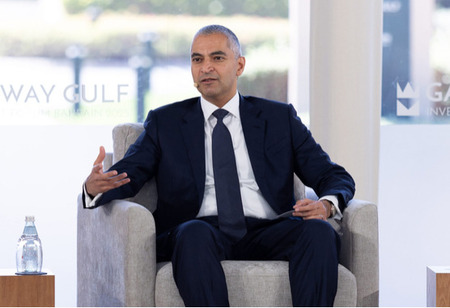
Khalid Humaidan, Governor of the Central Bank of Bahrain (CBB), emphasized the increasing influence of climate change on financial stability at the start of the second Climate Forum in Abu Dhabi.
Hosted by the Central Bank of the UAE (CBUAE), the forum took place under the sponsorship of Shaikh Mansour bin Zayed Al Nahyan, Vice President of the UAE, Deputy Prime Minister, chairman of the Presidential Court, and head of the CBUAE board of directors.
Also Read: Vietnam-Laos Ties Nurtured by the People: PM Le Minh Hung
In his keynote address, Humaidan emphasized the crucial importance of central banks and regulators in enhancing the financial sector's readiness for climate risks while fostering sustainable finance initiatives. He detailed Bahrain’s climate action plan, highlighting the nation’s objective to reach net-zero carbon emissions by 2060 while pursuing wider environmental and economic aims.
Humaidan emphasized that regional collaboration and the exchange of knowledge are essential for developing resilient financial systems and incorporating climate factors into monetary policy frameworks
The forum unites top policymakers, central bank representatives, and financial sector executives, along with global specialists in climate, finance, and financial stability, to address the effects of climate change on financial stability and monetary policy, as well as the importance of sustainable finance in moving towards a low-carbon, climate-resilient economy.
In his speech, CBUAE Governor Khaled Mohamed Balama emphasized the CBUAE’s involvement in the Network for Greening the Financial System (NGFS), which includes over 140 central banks and financial regulators, along with its co-chair position in the NGFS Workstream on Central Bank Operations, marking it as the first central bank in the Mena region to assume this role.
Earlier, in a step highlighting increasing economic collaboration throughout the Gulf, the Central Bank of the United Arab Emirates (CBUAE) and the Central Bank of Bahrain (CBB) have finalized a historic Currency Swap Agreement valued at around BHD 2 billion (AED 20 billion). Spanning a five-year period, the agreement represents a concerted initiative by both countries to enhance their financial stability and promote regional monetary collaboration.
Also Read: Fintech Forward Wraps Up With More than 60 MoUs
The accord — revealed during a digital signing event with CBUAE Governor H.E. Khaled Mohamed Balama and CBB Governor H.E. Khalid Humaidan — signifies more than merely a technical financial agreement. It denotes a collective strategic perspective: strengthening the Gulf’s status as a cohesive, stable, and internationally credible financial entity.
Currency swap agreements are established in the global market — they represent a complex financial tool frequently utilized to secure liquidity amid economic instability or to improve trade transactions in domestic currencies. For Bahrain and the UAE, this agreement holds significant economic and geopolitical implications.
Also Read: UAE and Singapore to Deepen Ties in Business and Philanthropy
In the past 10 years, the Gulf area has experienced a gradual transition from oil-dependent growth strategies to varied financial systems. Bahrain and the UAE have established themselves as banking and fintech centers in the region, focusing on long-term strategies to enhance international competitiveness and drive financial innovation. This swap arrangement aligns perfectly with that story — a concrete measure for monetary independence and international liquidity collaboration.