


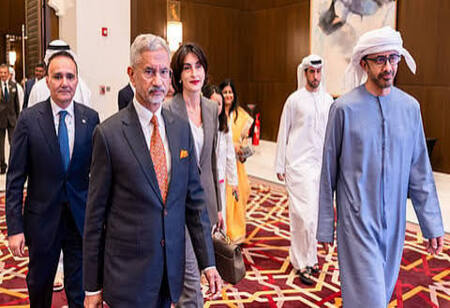
External Affairs Minister S. Jaishankar emphasized the need for "immediate" reform of multilateral institutions to align with the evolving global landscape, noting that enhanced collaboration among smaller country groups could facilitate this process.
Jaishankar commented during a session of the Raisina Dialogue's Middle East edition in Abu Dhabi, where he participated in a discussion with UAE Deputy Prime Minister and Foreign Minister Sheikh Abdullah bin Zayed Al-Nahyan on 'The World Ahead: Power, Purpose & Possibility'.
Emphasizing the accelerating changes in the global order during the discussion, the minister noted it represented both sustained trends and urgent disruptions, leading countries to seek out new alliances and options based on their unique situations.
"In that pursuit, new collaborations and innovative opportunities are undoubtedly examined," he stated in a social media update following the conversation.
Jaishankar stated that this necessitated countries to transcend conventional comfort zones and cultivate a more acute strategic awareness.
"The revision of multilateralism is pressing." He emphasized that it can be bolstered through more robust minilateralism.
Minilateralism denotes collaboration among a limited number of nations to tackle particular problems, often enabling more effective teamwork when wider multilateral platforms face difficulties in achieving agreement.
Jaishankar referred to the India-UAE collaboration over the last ten years as a demonstration of how nations have adapted to an evolving global landscape.
"The partnership between India and the UAE over the past ten years exemplifies how our two countries have adapted to the evolving global landscape," he stated.
Individually, Jaishankar also conducted a bilateral discussion with Zayed Al-Nahyan, calling it "cordial and fruitful."
In a social media update, Jaishankar mentioned that he and Zayed Al Nahyan "shared views on bilateral and global matters in the context of our Comprehensive Strategic Partnership."
Jaishankar reached the UAE on Wednesday for a three-day official trip to assess advancements in bilateral relations.
India and the United Arab Emirates (UAE) have grown their collaboration in trade, investment, energy, defense, and security over recent years.
Also Read: Oman Air Expands Winter Schedule With More Flights, Others
The Comprehensive Economic Partnership Agreement (CEPA), implemented in May 2022, has established a framework for enhancing bilateral trade and economic collaboration.
The UAE serves as a significant ally for India in the Gulf area, housing a substantial Indian expatriate population and being a crucial source of energy resources and investments.
Also Read: LG Electronics Emerges as Apple's Home AI Ally
The Indian expat community is the largest ethnic group in the UAE, representing around 35 percent of the nation’s population, as stated by the Embassy of India in Abu Dhabi. In 2024, the estimated population of resident Indian nationals in the UAE was 4.3 million.
Also Read: FADU Unveils World's First File-Semantic SSD to Power AI Workloads
Approximately 15% of the Indian diaspora resides in the Emirate of Abu Dhabi, with the remainder distributed among the other six emirates, such as Dubai.