


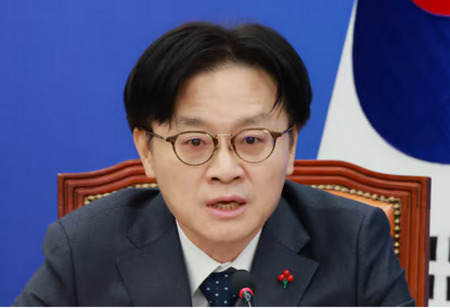
Industry Minister Kim Jung-kwan emphasized Korea's advantages in the competitive pursuit of Canada's prestigious submarine project, showcasing the nation's manufacturing strengths and the impact it could have on Canada's automotive industry.
Kim expressed these thoughts during a press conference, as Seoul anticipates Canada's upcoming announcement regarding the selected bidder for the estimated 60 trillion-won ($40 billion) initiative to construct up to 12 new conventionally powered submarines, which is set for late next month.
Also Read: Incheon Airport to Expand Smart Pass Corridors for Faster Boarding
The Korean consortium, including Hanwha Ocean and HD Hyundai Heavy Industries, is among the two final competitors for the prestigious project, competing with Germany's Thyssenkrupp Marine Systems.
Kim stated that Seoul can provide the KSS-Ⅲ class submarines, an "existing" and operational model, while Germany is still in the design phase for its submarine for Canada, emphasizing that the Korean submarine boasts superior features and price competitiveness.
The 3,000-ton ROKS Dosan Ahn Chang-ho, a KSS-Ⅲ class vessel, reached a Canadian port last week for joint exercises with the Royal Canadian Navy. It traveled approximately 14,000 kilometers across the Pacific Ocean, demonstrating the Korean naval submarine's capacity for long-range operations.
Also Read: Indonesia's Prabowo Arrives in France for State Visit
Extended endurance is an attractive quality of the Korean submarine, as the Canadian navy must oversee extensive areas of the Pacific, Atlantic, and Arctic oceans.
Regarding wider industrial collaboration, Korea holds an advantage over Germany, as significant Korean firms, such as Hyundai Motor and Hanwha Group, have suggested partnerships to develop a hydrogen mobility ecosystem and acquire military vehicles for Canada, Kim noted.
Concerning the current discussions on Seoul's planned investment in the US under the bilateral trade agreement concluded last year, the minister remarked that it's challenging to specify when the initial project will be unveiled, as the commercial viability of the potential projects needs comprehensive evaluation.
In January, Trump had threatened to increase reciprocal tariffs on Korean products from 15 percent back to 25 percent, referring to a setback in Seoul's legislative process required for the execution of the Korea-U.S. trade agreement, in which Korea committed to investing a total of $350 billion in the US.
Kim predicted that Korea's exports will exceed the significant $900 billion threshold this year for the first time in history.
Korea's exports surpassed $700 billion last year, achieving a record high due to robust semiconductor sales.
Also Read: Samsung Display Supplies 4 OLED Panels for Ferrari Luce
During the initial four months of this year, the nation exported a total of $306.5 billion in goods, marking the highest amount ever recorded for this three-month span. Kim stated that the government will strive to maintain this strong export momentum to position Korea as the fifth-largest exporter globally.