


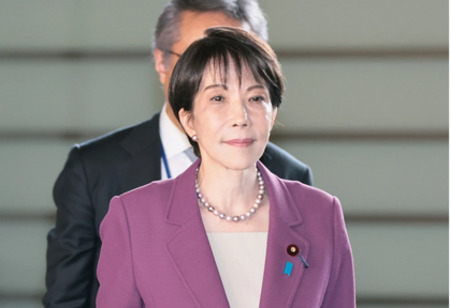
Prime Minister Sanae Takaichi presented a comprehensive vision for Japan's economic growth that emphasizes significant investment in artificial intelligence and semiconductors, along with other vital industries such as defense, space, and shipbuilding.
The strategy involves an investment exceeding ¥370 trillion ($2.3 trillion) over 14 years, concluding in March 2041, with ¥101.6 trillion specifically allocated for artificial intelligence and chip expenditures, as stated in documents issued following a meeting of a policy advisory panel.
Also Read: Jaishankar and South Korean FM Discuss Strategic Ties in Seoul
The plan requires a mix of public and private funding to achieve the desired totals, with the government expected to provide just under half if inflation aligns with projections.
The investment roadmap represents a significant milestone in Takaichi’s initiative to influence Japan’s growth strategy as technological advancements and geopolitical conflicts redefine economic priorities. The premier aims to direct investment into areas that can enhance economic security — ranging from supply-chain robustness to essential technologies — while fostering the nation’s long-term growth prospects by backing new industries.
Most of the funding for AI and chips will be directed towards semiconductors, which are essential for physical intelligent systems, along with vertical AI, tailored for a particular task or sector. The capital is intended to alleviate supply constraints by tackling persistent labor deficits in the aging country.
The plan projects that semiconductor investments will create ¥443 trillion in economic spillover by fiscal 2040, while investments in physical AI and vertical AI will yield ¥144 trillion and ¥222 trillion, respectively.
The investment plan is a component of Japan's continuous attempts to rejuvenate its semiconductor sector. According to the Industry Ministry, the government has allocated approximately ¥7.2 trillion for semiconductors and AI since launching a new strategy in 2021.
Also Read: Qualcomm to Provide Custom Chip-Design Services to ByteDance
Out of the total, the government has designated funds for particular initiatives like the state-supported chip project Rapidus Corp., which has been granted public assistance amounting to approximately ¥2.6 trillion.
The government published long-term economic and fiscal forecasts that include Takaichi’s growth strategy across three different scenarios. In the most favorable scenario, where the strategy performs as planned, the debt-to-GDP ratio is anticipated to decrease consistently, even with the government injecting ¥10 trillion in actual spending into the initiative annually.
In the other two scenarios — where technological and market uncertainties limit the strategy's effectiveness, or where existing trends continue — the ratio is expected to start increasing again in the 2030s. All three scenarios presuppose that inflation levels off at approximately two percent.
Takaichi’s administration has redirected its fiscal priorities to lessen the debt-to-GDP ratio, abandoning the primary balance target that had steered government policy for over twenty years. The debt-to-GDP ratio is typically viewed as easier to enhance in times of inflation.
The forecasts highlight the extent to which Japan’s financial future relies on the effectiveness of Takaichi’s growth plans. The projections do not consider the expenses from any increases in defense spending or possible reductions in consumption taxes, indicating that fiscal pressures may be more significant than the estimates suggest.
Also Read: LG Chem Bets on Semiconductors, Mobility, Robotics Materials
Takaichi’s economic plan has divided investor perceptions. In the stock market, her effort for significant investment enabled the Nikkei 225 to surpass 70,000 for the first time in history this month. Simultaneously, worries regarding fiscal sustainability contributed to driving super-long Japanese government bond yields to their highest levels in decades earlier this year.