


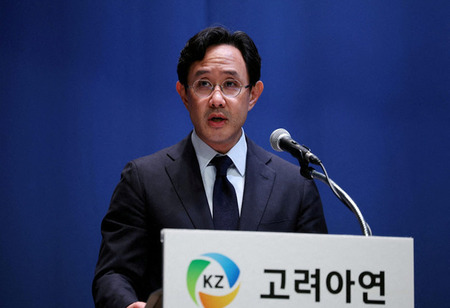
Korea Zinc Chairman Choi Yun-beom's faction won the recent battle for management control of the zinc smelter against the MBK Partners-Young Poong coalition, gaining an audit committee position that reinforced its board majority.
The alliance stated that it acknowledged the result but emphasized the importance of the newly elected board members being truly independent.
“An audit committee member is not a defensive seat for protecting Choi’s control, nor is an independent director a trophy to be claimed by either side,” it said in a statement. “Regardless of who nominated them, all directors must exercise independent judgment and perform their duties in the interests of Korea Zinc and all of its shareholders.”
Also Read: IEU-CEPA to Strengthen Market Access for Indonesian Goods
The vote was the most scrutinized topic on the agenda during Wednesday’s special shareholders’ meeting. Korea Zinc had to appoint a second member to its audit committee, a mandate that becomes effective Thursday due to the updated Commercial Act.
The organization has one member currently, Suh Dae-won, who received support from Choi’s faction last year. According to the updated legislation, companies on the list with assets of a minimum of 2 trillion won ($1.5 billion) are required to have at least two audit committee members chosen independently from the other board members.
Young Poong and MBK Partners, the main shareholders of the smelter, had supported Park Yoo-kyung, who previously served as the Asia-Pacific managing director for responsible investment and governance at APG Asset Management. Choi’s team proposed Baek In-kyoo, the ex-chairman of Deloitte Korea’s board and leader of the group’s ESG Center.
Baek achieved a clear victory, obtaining 5.09 million of the 6.23 million shares present at the meeting, equating to 81.8 percent of the vote.
His backers highlighted his proficiency in financial reporting and internal control systems. Baek, a certified public accountant in Korea and the United States, would enhance the committee's oversight capabilities, according to Choi's camp.
Also Read: Kookmin University Joins Qatari Sustainability R&D Organization
Wednesday’s result was affected by the Commercial Act’s new voting regulation aimed at reducing the power of large shareholders. Referred to as the “3 percent rule,” it limits the voting rights of the largest shareholder and their associated parties to 3 percent.
This indicated that the ownership stakes of both sides held significantly less importance than they did before. The MBK-Young Poong partnership owns approximately 42.1 percent of Korea Zinc, whereas Choi’s faction is thought to manage around 38.76 percent via supportive shareholders.
This resulted in institutional investors, such as the National Pension Service, key shareholders like Hanwha Group and LG Group, along with minority shareholders having significantly more influence on the result.
Also Read: Hyundai Motor to Introduce Hydrogen Fuel Cell Buses in Oman
At the meeting, shareholders elected four additional independent directors, with two nominated from each side. Choi recommended Lee Hyung-kyu, a professor emeritus from Hanyang University School of Law, and Seo Eun-sook, an economics professor at Sangmyung University. The alliance nominated Lee Jun-bong, a law professor at Sungkyunkwan University, and attorney Shim Hye-seop.
In the end, the changes grew the board from 14 to 19 members, with Choi’s group raising its representation from nine seats to 12, while the MBK-Young Poong group increased from five to seven. The vote was largely seen in the industry as an endorsement of Choi’s leadership during the ongoing control conflict, which has persisted since 2024. Several analysts viewed it as a choice for stability as Korea Zinc undertook significant investments under Choi’s guidance, such as Project Crucible, its proposed integrated smelter in Tennessee.
The struggle for control of the board, nonetheless, is probably not over. Suh's and eight other directors' terms will end at the annual shareholders' meeting in March, providing both parties another chance to evaluate their backing from shareholders.