


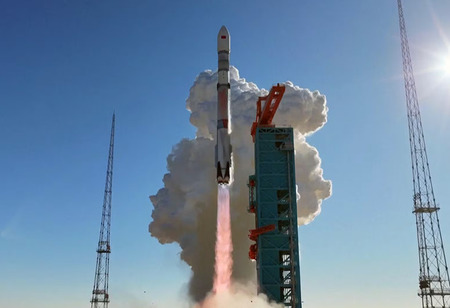
Chinese commercial rocket startup LandSpace successfully retrieved the first stage of its Zhuque-3 launch vehicle, making it just the third private company worldwide to land an orbital-class booster and greatly reducing the technology divide with the US in reusable rocketry.
This accomplishment positions LandSpace with SpaceX and Blue Origin as the sole private companies to have proven this capability. Retrieving and reusing boosters is seen as essential for reducing launch expenses and turning space access into a viable commercial enterprise.
Also Read: UAE Banking System’s Total Assets Rise to AED5.3 Trillion
The 66.1-meter Zhuque-3, a stainless-steel rocket regarded as China's counterpart to SpaceX's Falcon 9, launched from the Dongfeng Commercial Space Innovation Pilot Zone in northwestern China. The first stage with nine engines landed at a site in Gansu Province, 390 kilometers southeast of the launch pad, as reported by state media.
The successful touchdown occurred during LandSpace's second attempt. The initial Zhuque-3 launch in December 2025 successfully reached orbit with its second stage, but the booster experienced an anomaly during the final landing burn, preventing a soft landing. Engineers concentrated on enhancing the landing propulsion system for this second mission, minimizing the number of engines employed for the final descent burn to streamline system design and boost reliability.
In addition to the booster recovery, the mission successfully placed the Honghu-03 satellite into its intended orbit, marking the first occasion when the rocket achieved both orbital insertion and vertical landing of the first stage in one flight.
The timing holds considerable importance for LandSpace's goals of raising capital. The firm is now in the inquiry stage of its IPO on the STAR Market of the Shanghai Stock Exchange, having submitted an updated prospectus in June. LandSpace aims to secure 7.5 billion yuan (around $1.1 billion) to aid in development and enhance its reusable launch services. The firm has stated its goal is to achieve profitability by 2029.
LandSpace has highlighted various design features that set the Zhuque-3 apart from the Falcon 9. The rocket's airframe is made from stainless steel, which the company claims provides better heat resistance and possible reductions in manufacturing expenses compared to the aluminum-lithium alloy utilized in SpaceX's main vehicle. The Zhuque-3 utilizes methane and liquid oxygen, a propellant pair that combusts more cleanly than the Falcon 9's combination of liquid oxygen and kerosene.
Also Read: Dentsu's CEO Puts AI and Others for Global Transformation
The rocket is capable of carrying 14.2 metric tons to low Earth orbit on a single-use mission, whereas the Falcon 9 can lift 22.8 tons. LandSpace seeks to recycle every Zhuque-3 booster as many as 20 times. In comparison, SpaceX launches the Falcon 9 around 150 times each year—approximately three times weekly—and has reused specific boosters over 36 times.
The landing of Zhuque-3 signifies one of two different technical approaches that China is exploring for recovering rocket stages. In July 2026, the state-designed Long March 10A achieved the nation's first controlled recovery of its first stage through a sea-based net capture system on a floating platform—an unprecedented milestone for this technique. The Long March 10A lacks landing legs; rather, the netting of the recovery platform cushions the impact and steadies the booster.
Also Read: King's Visit to China Offers to Deepen Economic Cooperation
LandSpace has stated it aims to try its initial reflight of a recovered booster as soon as feasible using data from this mission. Completing that cycle—launch, recovery, inspection, maintenance, and relaunch—would signify the company's shift from engineering demonstration to true commercial reusability.