


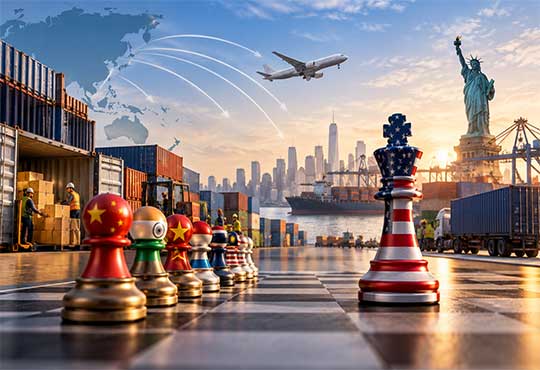
 For a decade, an Asian SMB founder selling into the United States could build a business on a single, quiet assumption: a parcel worth under $800 crossed the U.S. border duty-free, no broker required. That assumption ended in 2025, and the leaders who adjusted fastest are not the ones who simply absorbed the extra cost. They are the ones who used the disruption to rethink how their business reaches the U.S. market in the first place.
Executive orders issued between February and August 2025 stripped the $800 de minimis exemption first from Chinese and Hong Kong goods, then from every country of origin, and U.S. legislation has since repealed the provision entirely for commercial shipments. For manufacturers and exporters across Southeast Asia, South Asia, and China selling directly to American consumers, this was not a policy footnote. It was a structural change to the cost of doing business with their single largest export market, and it landed with little warning.
What separates the leaders who navigated it well from those still catching up is instructive, and it has less to do with trade policy expertise than with how they lead through disruption generally.
They Treated the Shock as a Signal, Not a Setback
The founders who came through this transition strongest did not spend months lobbying for the old rule to return. They read the change for what it was: a permanent shift in the economics of shipping small parcels, and a prompt to ask whether their sourcing and fulfillment model still made sense. A product that sold well enough to justify per-order shipping under the old duty-free threshold often makes more sense today bought and shipped in volume, at wholesale pricing, with the customs overhead spread across a full container rather than absorbed on every single unit. That is not a defeat. For many businesses, it is the natural next stage of growth that de minimis had, in effect, allowed them to delay.
They Rebuilt Visibility Into the Supply Chain, Not Just Cost Controls
The immediate instinct after a cost shock is to look for the cheapest way to absorb it. The leaders who handled this well went further and asked a harder question: did we actually understand our landed cost before this happened? Many did not, because the exemption had made that calculation unnecessary. Rebuilding that visibility, knowing what duties, freight, and customs costs apply to a shipment before it leaves the factory, has become a basic requirement of running an export business rather than a specialized function reserved for large importers with dedicated logistics teams. Digital freight platforms such as Ship4wd have grown into this gap specifically because SMB exporters now need the kind of real-time rate and customs visibility that used to be the preserve of enterprise shippers with in-house logistics staff, delivered through a platform rather than a relationship they have to build from scratch.
They Separated the Policy Noise From the Operating Decision
U.S. trade policy has moved quickly and unpredictably enough since 2025 that a leader who tries to plan around every tariff announcement will spend all their strategic bandwidth reacting to Washington instead of running the business. The founders who managed this well drew a clear line between watching policy developments, which their teams still do, and making operating decisions based on the current, confirmed rules rather than speculation about what might change next. That discipline matters more in a volatile trade environment than in a stable one, precisely because the temptation to overreact to every headline is stronger.
They Used the Disruption to Diversify, Not Just Adapt
For some exporters, the end of de minimis became the occasion to reduce reliance on a single sales channel or a single market. A business that had built its entire model around direct-to-consumer parcels into the U.S. found itself asking whether wholesale partnerships, regional diversification within Asia, or a stronger presence in markets with more stable trade terms might reduce its exposure to any single country's policy decisions. That is a harder, slower path than simply absorbing a cost increase, but it is the kind of structural response that leaves a business more resilient the next time trade policy shifts, and given the pace of change since 2025, there is little reason to assume it will not shift again.
The Broader Lesson for Asian Business Leaders
The end of de minimis is, in one sense, a very specific customs story. But the leadership pattern it reveals is a general one: the businesses that treat a policy shock as new information to act on, rather than an injustice to wait out, tend to come through it stronger. That requires the discomfort of admitting that a business model built on a favorable rule was always more fragile than it felt while the rule held, and the discipline to rebuild on a foundation that does not depend on any single government's next executive order.
For Asian exporters watching Washington's next move, that is probably the more useful question to sit with: not what the policy will do next, but whether the business is built to withstand it either way.