


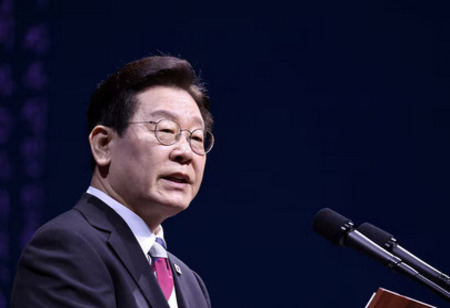
President Lee Jae Myung stated that the administration will strive to achieve "absolute competitiveness" in advanced technologies to transform the nation into an industrial giant.
The president delivered his comments while detailing his policy vision and objectives for his second year in office during a press conference commemorating the first anniversary of his inauguration on June 4 last year.
Also Read: Prabowo Welcomes Qatari Deputy PM at Merdeka Palace
"Lee stated that by utilizing all resources from the government and private sector, competitiveness in the advanced technology sector will be ensured, noting that a major investment initiative will be announced shortly."
The president pointed out that the intended investment initiative will lead to a significant shift in the nation’s growth strategy.
The government will also look into new sectors, in addition to the semiconductor industry, that can act as growth drivers for future generations, he noted. Lee, however, emphasized that "fruits of growth" shouldn't be confined to specific companies, areas, or industries.
He also promised a firm response to irregularities and injustices, such as stock price manipulation and crimes related to real estate, while committing to persistently pursue structural reforms intended to break down entrenched interests.
Regarding national security, the president stated he will exert maximum efforts to obtain "tangible results" in the nation's endeavor to acquire nuclear-powered submarines and restore wartime operational authority of troops from Washington.
Also Read: Vietnam Elevate its Ties and Global Standing With Singapore
The president stated that the government will steadfastly continue its efforts to achieve peace and security on the Korean Peninsula, along with peaceful coexistence and mutual prosperity with North Korea.
When questioned about the record profits of semiconductor leaders like Samsung Electronics, the president emphasized that the matter of leveraging higher tax revenues from increased corporate earnings is entirely separate from potential uses of corporate profits or the imposition of additional taxes on those earnings.
"It is a challenging problem" but one that mustn't be completely overlooked, he mentioned, suggesting the matter might necessitate and soon prompt global conversations. The comments followed a recent wage agreement by a labor union at Samsung Electronics that provided a significant bonus package for chip workers, after months of threatening a general strike in light of soaring profits from the AI-focused semiconductor sector.
In an effort to control soaring home prices, Lee mentioned that the government could implement real estate tax reforms as soon as next month and unveil a new housing supply strategy soon. The president indicated a potential change to the homeownership tax, stating, "In our country, the property tax on homes is typically low." "People might find it easy to amass (houses)." He mentioned that the initiative might motivate homeowners to put their properties on the market.
Also Read: Indonesia Pushes Mass Transit to Cut Fuel Subsidy Costs
Citing the robust performance of the benchmark Korea Composite Stock Price Index (KOSPI) lately, the president noted his belief that Korean stocks are still somewhat undervalued. "Stock prices have increased more rapidly than anticipated, yet I still believe they are somewhat undervalued," Lee stated, referencing diminished geopolitical risks, enhanced policy predictability, and initiatives to eliminate market manipulation as elements that could further bolster the market.
Lee had committed during his presidential campaign to elevate the KOSPI to the 5,000-point mark. The index was fluctuating in the mid-2,000 range prior to his arrival in office and subsequently exceeded the 8,000-point threshold.