


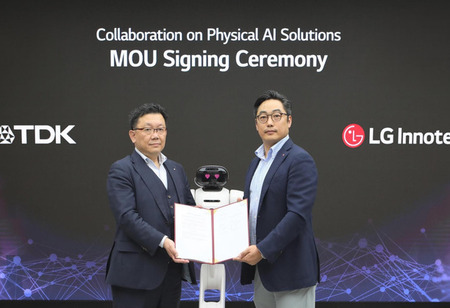
LG Innotek is collaborating with the Japanese electronic component firm TDK to advance essential sensing technologies for physical AI.
The plan is to hasten the initial entry into the AI robot market by collaboratively creating advanced sensing solutions for robots that encompass data like movement, touch, and sound, advancing past current vision-focused sensing technologies.
Also Read: Vietnam Sets Vision for Dong Nai as Asia-Pacific Aviation Hub
LG Innotek revealed on July 28 that it has established a strategic alliance in the physical AI sector with TDK.
The two firms aim to collaboratively create essential components for robots, including next-gen vision sensing modules and tactile sensing modules, by merging LG Innotek’s optical and ultra-precision design expertise with TDK’s sensor technologies.
LG Innotek aims to launch a vision sensing module that includes an inertial sensor in 2027. As a result, the two firms will initially start enhancing the vision sensing module. The goal is to create an advanced vision sensing module that can analyze not just visual images but also motion, direction, and audio data by integrating TDK's inertial measurement unit (IMU), position sensors, and microphones with LG Innotek's vision sensing module.
Existing vision sensing modules have concentrated on recognizing visual information from cameras, whereas the new module aims to enhance the accuracy of the robot's understanding of its environment by thoroughly analyzing different sensor data.
Also Read: China Memory Chipmaker CXMT's Shares Soar in Blockbuster Listing
Using TDK’s inertial sensor with LG Innotek’s vision sensing module improves object recognition stability by real-time correction of image distortion due to shaking and other motions as the robot operates.
Robot manufacturers can lessen their development workload by obtaining a combined module rather than having to buy and connect various sensors separately.
The two firms have also decided to collaboratively create a tactile sensing module aiming for completion by 2027. The tactile sensing module is a device connected not just to the hands of robots but also to their arms and bodies to sense contact and pressure, functioning in a manner akin to human skin. It is an extremely challenging product that necessitates the creation of ultra-thin, ultra-accurate, and flexible structures, and it is regarded as an essential element of next-generation robots in conjunction with vision sensing.
In this partnership, LG Innotek will handle module design and digital signal processing technology, whereas TDK will supply tactile sensing technology gained from the consumer goods and automotive sectors to create tactile sensing modules tailored for diverse robot working environments.
Also Read: LG CNS Joins Global AI Alliance for New Materials Discovery
The two firms intend to broaden their collaborative efforts in physical AI moving forward, incorporating technology that analyzes and processes sensor data in real time.
Noboru Saito, President and CEO of TDK, says, “I am pleased to join hands with LG Innotek, a world-class physical AI sensing company,” adding, “We will introduce products that can change the market landscape by combining TDK’s proprietary technologies and sensors with LG Innotek’s core technologies.”
Moon Hyuk-soo, CEO of LG Innotek, states, “‘Multi-Sensing,’ which combines numerous sensors in the robotics field, will draw attention,” adding, “We will lead the core robot component ecosystem through cooperation with TDK, which possesses various types of sensors.” He also emphasized, “We will continue to cooperate with various companies to upgrade the core technological prowess applied to the eyes and hands of robots and accelerate our preemptive entry into the physical AI market.”
TDK is a worldwide electronic component firm based in Japan, equipped with diverse sensor technologies such as inertia, position, pressure, and temperature. Specifically, it is assessed as having established a comprehensive sensor range applicable in the physical AI domain.