


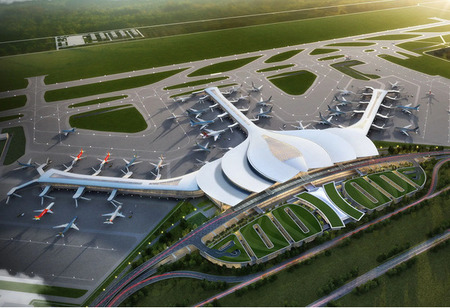
The Politburo has endorsed a long-term development plan designed to turn the newly founded Dong Nai City into a significant Asia-Pacific aviation hub focused on Long Thanh International Airport, while providing it with unique policy frameworks to boost growth.
The resolution, endorsed by General Secretary and State President To Lam, establishes development objectives through 2035 with a vision extending to 2065, positioning Dong Nai as a global airport city and a fresh growth driver for southern Vietnam.
The Politburo indicated that Dong Nai's growth has not lived up to its potential because of institutional limitations and a lack of adequate utilization of new growth factors, urging a strategic transition to an open development model backed by cohesive transport infrastructure and multi-centre urban design.
According to the resolution, Dong Nai is anticipated to evolve into a multi-functional growth hub spearheading sectors such as aviation, aerospace, high technology, logistics, cross-border trade, high-tech agriculture, and innovation, leveraging Long Thành’s position as an international airport city with worldwide connectivity.
By 2035, Dong Nai intends to evolve into a green, intelligent airport city featuring advanced manufacturing, aviation, and aerospace sectors, along with a globally competitive aviation economy.
By 2045, the city is anticipated to transform into a contemporary aviation hub for the Asia-Pacific area and a knowledge-driven economy characterized by elevated human development metrics and advanced urban governance. By 2065, it aspires to be one of the premier multi-functional airport cities globally, offering an excellent quality of life.
The Politburo established a goal of yearly gross regional domestic product (GRDP) growth of no less than 10 percent from 2026 to 2045, decreasing to a minimum of eight percent each year from 2046 to 2065.
Also Read: Cohesity Appoints Peter Hanna as VP & GM for Asia Pacific, Japan
Dong Nai's GRDP is expected to hit $44 billion by 2030, increase to $70 billion in 2035, $150 billion in 2045, and $600 billion by 2065. Per capita GRDP aims to rise from $9,200 in 2030 to $67,500 by 2065. The digital economy is projected to represent a minimum of 30 percent of GRDP by 2030 and 40 percent by 2035, with an urbanisation rate goal of 65 percent by 2030.
To bolster these goals, the Politburo specified eight categories of policy actions, encompassing institutional reforms, strategic planning, infrastructure investment, innovation-led growth, and social advancement. The resolution provides Dong Nai with expanded decentralisation and decision-making authority across nearly all sectors, excluding national defence, security, foreign affairs, and religious matters. It enables the city to implement specific policy mechanisms akin to those currently used in HCM City in sectors like investment, finance, budgeting, land management, urban planning, construction, science and technology, digital transformation, and strategic investor attraction.
Also Read: Trump Signs Landmark Nuclear Sharing Deal with Saudi Arabia
The Politburo additionally approved the creation of special economic zones, free trade areas, concentrated digital tech parks, innovation hubs, and higher education zones associated with Long Thành International Airport. The strategy outlines multiple significant development corridors, such as the HCM City-Bien Hoa-Long Thanh-Phuoc An Port route serving as a corridor for aviation, seaport, logistics, and services, in addition to other industrial, cross-border trade, and tourism corridors linking the Central Highlands, south-central coast, and Cambodia.
The Dong Nai River is set to be enhanced as the city’s key ecological and urban landscape corridor. The resolution further requests the expedited construction of Long Thanh International Airport and associated transport infrastructure, encompassing the airport's second phase, the Bien Hoa-Vung Tau railway, and regional transport connections.
Also Read: Vietnam Promotes Ties With Canada and New Zealand at AMM-59
Long Thanh International Airport is designed to be Vietnam's main international air travel entry point and a regional transfer center connected to worldwide supply networks. The Politburo instructed planners to create the Long Thanh-Nhon Trach urban zone and its airport vicinity to support an urban population exceeding 2.5 million residents, establishing a basis for an airport city that meets international standards.