


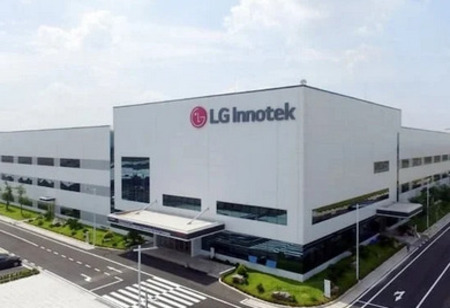
LG Innotek announced that it is collaborating with a North American Big Tech firm to create large semiconductor substrates for artificial intelligence (AI) purposes, anticipating "tangible results" by the year's end.
The firm revealed its substrate business strategy at a press briefing at its headquarters in western Seoul, stating that it aims to reach over 1 trillion won ($662.6 million) in yearly operating profit from the business by 2031, which represents an increase of nearly 10 times compared to last year’s 128.9 billion won.
Also Read: Innocean, SBVA Partner to Support Growth of AI, Tech Startups
At the conference, Cho Ji-tae, head of LG Innotek's Package Solution Business, along with Myeong Se-ho, vice president of development for the unit, stated that the company is working on large flip chip-ball grid array (FC-BGA) substrates and is engaging in discussions about collaborative development plans with customers in North America.
FC-BGA is a sophisticated substrate utilized for AI servers, supporting the mounting of chips like central processing units, graphics processing units, and high-bandwidth memory. With processors growing in capability, chip manufacturers are aiming to create more memory chips on substrates, leading the competition to focus more on producing larger substrates with greater density.
The FC-BGA exceeding 100 bodies that Cho refers to involves products that exceed 100 millimeters on each edge, categorizing them as some of the largest substrates now in development for AI uses. At the conference, the company announced that customers are already asking about 200-millimeter products.
Also Read: Indonesia, Australia Bolster Research and Higher Education Ties
The firm announced it anticipates that the large-scale production of server network FC-BGA substrates is expected to start in the latter half of this year, whereas FC-BGA substrates for AI training and inference are projected to commence in 2027.
"Looking at global substrate makers, most have already secured advance orders based on long-term agreements through 2029," Cho said. "These are not simple verbal arrangements but binding contracts with strong penalty clauses tied to market fluctuations, which is why we believe long-term growth in the AI semiconductor substrate market remains solid … We are also prioritizing our manufacturing capacity for customers that have made financial commitments."
At the conference, the company presented its substrate offerings of FC-BGA, Radio Frequency-System in Package (RF-SiP) for smart device communication modules and antennas, and Flip Chip-Chip Scale Package (FC-CSP) for mobile application processors (APs) and low power memory chips.
LG Innotek maintains a top position in RF-SiP, capturing a 65 percent market share last year among the leading five customers of radio frequency modules globally.
Also Read: Naver, Krafton Team Up to Bring PUBG Esports to Bigger Audiences
The firm stated that RF-SiP demand is anticipated to stay robust as the connectivity requirements for smart glasses and extended reality devices grow, with the technology also being embraced in satellites. The demand for FC-CSP is increasing as a result of smartphone APs and energy-efficient memory chips.
LG Innotek is set to start building a new semiconductor substrate facility in Vietnam this month, initially focusing on expanding RF-SiP and FC-CSP production to satisfy customer demand. The firm intends to allocate approximately 1 trillion won for RF-SiP and FC-CSP facilities, in addition to hundreds of billions of won for increasing FC-BGA production.