


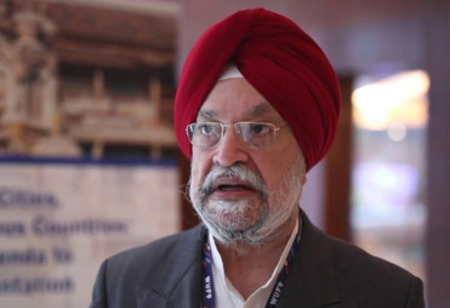
The Oil Minister, Hardeep Singh, is embarking on a two-day official visit to Qatar, the largest supplier of LNG in India, starting on Thursday amid the ongoing conflict in West Asia that is affecting the supply of oil and gas.
Puri's trip coincides with a decrease in India's imports of liquefied natural gas from the Arab nation in March 2026, reaching their lowest levels on record due to the closure of the Strait of Hormuz caused by conflict in West Asia.
Also Read: Prabowo Meets Emperor Naruhito, Bolstering Indonesia-Japan Ties
In addition, assaults on Qatar's infrastructure for producing oil and natural gas have already had an effect on the availability of the highly refrigerated resource, sparking worries about the process of repairs and the resumption of supplies.
Kpler, a prominent global real-time data and analytics provider, recently highlighted that India continues to have significant dependence on the Middle East, particularly in terms of its LNG imports, which are largely governed by long-standing agreements with QatarEnergy.
The International Energy Agency (IEA) has calculated that there has been a roughly 20 percent decrease in global LNG supply as a result of the current situation. The interruption in transit through the Strait of Hormuz has led to a decrease in supplies from Qatar and the UAE of more than 300 million standard cubic meters per day (MSCMD) since March 1, resulting in a weekly loss of over two billion cubic meters (bcm) of gas supply.
The Ras Laffan facility in Qatar, currently the world's largest liquefaction facility, has been non-operational since the initial attack on March 2nd.
The Energy and Gas sector in the region has also been impacted due to the closure of oil fields, resulting in a reduction in gas production associated with oil extraction, according to the International Energy Agency (IEA).
In the year 2025, Ras Laffan achieved a remarkable output of 112 billion cubic meters of LNG, in addition to 300,000 barrels daily of liquefied petroleum gas (LPG) and 180,000 barrels daily of condensate, firmly establishing itself as the leading LNG facility globally. During the months of January and February 2026, sourcing is expected to become a challenging aspect in the market due to its continued tightness. As storage levels decrease following the winter season in the Northern Hemisphere, the demand for LNG is predicted to rise in the coming months.
Also Read: Science Ministry Offers Water Management Aid to Mekong Nations
Additionally, the significant decrease in production from QatarEnergy's Ras Laffan facility is anticipated to further intensify the constraints in the market, according to the International Energy Agency (IEA). In 2025, the Strait of Hormuz saw the passage of over 110 billion cubic meters of LNG. The majority of LNG exports from Qatar and the UAE, amounting to 93 percent and 96 percent respectively, flowed through this strategic waterway, accounting for nearly 20 percent of the world's LNG trade.
The report also noted the lack of alternative pathways for transporting these significant quantities to market. The majority of liquefied natural gas (LNG) originating from Qatar and the United Arab Emirates is directed towards the Asian region. By the year 2025, nearly 90 percent of the aggregate amount of LNG shipments passing through the Strait of Hormuz were designated for consumption in Asian markets.
Slightly more than 10 percent of the gas supply was allocated to Europe. Nonetheless, similar to the oil industry, prolonged disturbances could lead to widespread ramifications on a global scale. Nations with established agreements with the United Arab Emirates or Qatar would be compelled to seek alternative sources in the LNG spot market. Consequently, this shift would result in an escalation of natural gas costs internationally.
Also Read: Dubai Chamber of Commerce Discusses Essential Goods Availability
QatarEnergy has indicated that the estimated financial toll of the missile strikes on its Ras Laffan Industrial City on March 18-19 is around $20 billion, resulting in a significant loss in annual revenue and a repair timeline of up to five years. This will inevitably affect the supply of energy resources to markets in Europe and Asia. The necessary repairs to the LNG facilities are expected to span between three to five years. Furthermore, the attacks have led to the temporary shutdown of approximately 1.281 million metric tonnes of LPG, equating to about 13 percent of Qatar's total exports.