


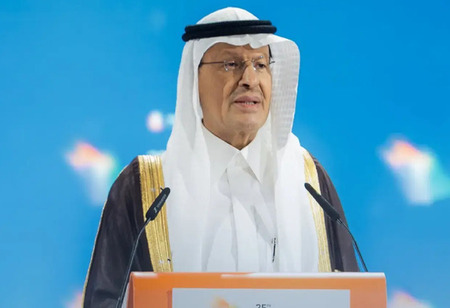
The 25th WPC Energy Congress in Riyadh has been inaugurated by Saudi Arabia’s Minister of Energy and Minister of Industry and Mineral Resources, Prince Abdulaziz bin Salman bin Abdulaziz, gathering government officials, industry leaders, investors, and energy specialists to deliberate on the future of worldwide energy systems.
Running until October 15 and themed “Pathways to an Energy Future for All,” the congress is notable as the first international event of its kind hosted by Saudi Arabia in over 90 years. Conversations will center on energy security, supply and demand, investment, technological advancements, sustainability, and the development of human capital.
Also Read: UAE, Thailand Conclude CEPA Negotiations, Eye Trade, Investment
In his initial speech, Prince Abdulaziz stated that the Kingdom will persist in addressing challenges, fulfilling its obligations, and following its long-term vision while upholding its duty to future generations. He emphasized Saudi Arabia’s evolution in recent years and its commitment to enhance its energy and industrial strengths.
The minister highlighted that recent global and regional events had shown the significance of energy security, especially with the strain on supply routes and risks to essential infrastructure. He stated that Saudi Arabia had invested for years in the infrastructure and capabilities necessary to endure disruptions, such as spare production capacity, storage facilities, alternative export routes, technology, domestic supply chains, and workforce training.
Prince Abdulaziz characterized localisation as beyond just an economic goal, referring to it as a strategic asset that allows for business continuity and quicker recovery during disruptions in international supply chains. He mentioned that energy resilience ought to be assessed not just by production capability, pipelines, or electrical output, but also by the capacity to sustain infrastructure, fix damage, reroute supplies, and bounce back from unforeseen interruptions.
Also Read: Oman Expo Sees Over $1.4 Billion Deals in Tourism, Real Estate
The minister stated that readiness needs to be cultivated and maintained over time, with Saudi Arabia's capacity to endure interruptions and resume operations bolstering the dependability of global energy supplies and strengthening its position as a reliable partner in the international economy. He emphasized that achieving an inclusive energy future requires universal energy security, noting that the transition in the energy sector and the dependability of supplies need to advance simultaneously.
Saudi Arabia will persist in investing in reliable oil and gas resources while enhancing renewable energy, bolstering electricity networks and storage capacity, improving gas infrastructure, and promoting lower-emission technologies.
Prince Abdulaziz reiterated Saudi Arabia’s dedication to achieving the goals of Saudi Vision 2030 by persistently investing in its energy infrastructure and industrial strengths, while fostering the well-being of its citizens and upholding global collaborations.
WPC Energy President Pedro Miras emphasized Saudi Arabia’s increasing influence in worldwide energy frameworks via investment, innovation, and technological advancement. Miras stated that the world was developing innovative technologies and energy solutions to enhance global energy security, bolster economic stability, and elevate living standards, as fast-evolving economies demand better infrastructure and more sustainable energy systems. He characterized energy security as essential for economic growth and social stability, emphasizing that an effective energy transition demands ongoing, long-term investment.
Also Read: LS Electric Partners Formosa Plastics for Taiwan Expansion
Miras also emphasized the increasing significance of artificial intelligence, digitalization, alternative fuels, and carbon capture technologies in influencing the future of the industry. He urged for enhanced global collaboration to promote common goals and create a secure, dependable, and sustainable energy future. The congress agenda includes ministerial discussions along with strategic and technical sessions exploring energy markets, investment prospects, emerging technologies, carbon management, natural gas, critical minerals, digital transformation, and artificial intelligence.