


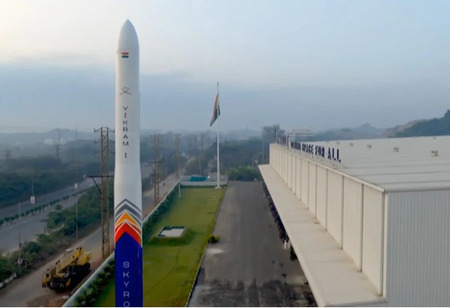
Singapore's High Commission in India showed support for Skyroot Aerospace's Vikram-1 mission, stating that the launch exemplifies the enhancing collaboration between Singapore and India in the space industry.
It pointed out that Skyroot Aerospace, supported by Singapore's sovereign wealth funds GIC and Temasek, is prepared to conduct India's initial private orbital launch.
Also Read: Hyundai Motor Group to Take Full Ownership of Boston Dynamics
"Backed by GIC & @Temasek, @SkyrootA is set to make India's first private orbital launch," the High Commission said in the post.
The announcement coincides with the upcoming inaugural test flight, "Mission Aagaman," of India's first privately developed orbital-class rocket, Vikram-1, created by Skyroot Aerospace in Hyderabad, set for July 18 at 11:30 AM from the Satish Dhawan Space Centre in Sriharikota.
"Singapore-India ties are reaching for the stars! Backed by GIC & @Temasek, @SkyrootA is set to make India's first private orbital launch. Praying for #Vikram1's success! HC Wong@isro @INSPACeIND @DrJitendraSingh @PawanKChandana @bharathdaka#MissionAagaman #SpaceTech pic.twitter.com/h70XywFaYo- Singapore in India (@SGinIndia) July 17, 2026"
The 24-meter rocket signifies the inaugural attempt by an Indian private firm to launch satellites into orbit utilizing its own launch system, without reliance on a government-designed rocket or launch program.
Also Read: TSMC Plans to Invest Another US$100 Billion in Arizona Fabs
Constructed completely from a lightweight carbon-composite framework, Vikram-1 is driven by three solid-fuel stages along with a liquid orbital correction module.
The mission aims to launch payloads of up to 350 kg into a 450-km Low Earth Orbit (LEO) at a 60-degree angle. Included in its payloads is a lab-created "Diamond Lotus" designed by Cosmos Diamonds based in Bengaluru.
IN-SPACe Technical Director Rajesh Jothi stated that the mission demonstrates the swift expansion of India's private space industry subsequent to the space sector reforms introduced in 2020.
Also Read: Vietnam, Cambodia Push Cross-Border E-Commerce, Bolster Exports
"We are seeing the growth of the private sector. We started with hardly five or six startup companies, and today we have more than 400 startups. This has happened because of the government space reforms in 2020, after which IN-SPACe was formed in 2022. The vision of our Prime Minister is now being implemented, and we are seeing the outcome of the space policy," he says.
He mentioned that the success of Vikram-1 could greatly enhance India's commercial launch potential.
"Skyroot is now going to launch its first maiden launch vehicle, which will be the first of its kind. Not only in India, but outside India as well, only one or two countries have such a small satellite launch vehicle. If this succeeds, it is going to give a boost to both the small satellite market and the small launch vehicle market," he adds.
Skyroot Aerospace Co-founder and COO Naga Bharath Daka mentioned that the company was established eight years ago with the aim of creating cost-effective and dependable launch services from India for international satellite operators.
"We started Skyroot around eight years ago with an aim to build affordable, reliable rockets from India to the world and provide affordable, reliable and on-demand launch access solutions for satellite operators around the world. All our effort and the team's effort are culminating today in this historic milestone," he says.