


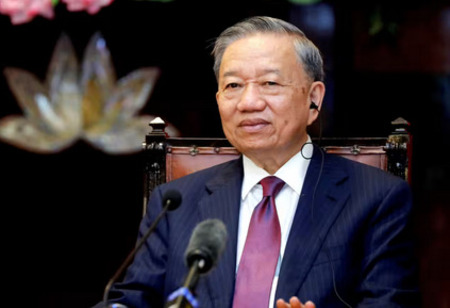
The General Secretary of the Communist Party of Vietnam Central Committee and President To Lam has requested enhanced research, forecasting, and strategic advisory capabilities to address the nation’s development needs in the future.
General Secretary and President To Lam praised the commission, the Vietnam Academy of Science and Technology (VAST), and the Vietnam Academy of Social Sciences (VASS) for their proactive involvement in developing key policies and projects. He also credited these accomplishments in part to the commission's officials, research institutions, universities, and Vietnamese scholars overseas.
Also Read: UAE Plans $25 Billion Investment in India, Trade Target
He emphasized that the quantity of reports or projects isn't a thorough indicator of advisory quality, highlighting instead that it's crucial for research to pinpoint issues early, accurately grasp their causes, choose suitable policies, and effectively address challenges in practice.
He observed significant research potential in the country, but it remains untapped and uncoordinated as a unified strength.
The commission ought to link the resources of the two academies, research institutes aligned with ministries and sectors, universities, businesses, and both domestic and international experts with the advisory needs of the central leadership. He emphasized the significance of precisely pinpointing issues, engaging the appropriate individuals promptly, and integrating research results into decision-making at the proper moment.
The aim is to develop robust research, forecasting, and strategic advisory capabilities.
The commission ought to take charge of pinpointing problems, establishing research needs, consolidating evidence, and developing advisory alternatives. In the meantime, both academies ought to maximize their ability to carry out thorough research, analyze data, make predictions, and provide feedback.
Research teams should be structured around strategic matters, uniting specialists from both academies, research institutes of ministries and sectors, universities, and companies, with roles and anticipated results made clear, he stated. He stated that research assignments must outline questions, deadlines, and requirements clearly while honoring scientific independence, recommending that scientists participate from the drafting phase for significant projects.
Also Read: RSG Launches ‘Yacht Network’ to Link Amaala, Red Sea Destinations
The highest-ranking official stated that researchers must have access to essential information while upholding confidentiality and scientific integrity, as well as being accountable for their suggestions.
He asked for adaptable methods to deploy talent, such as interdisciplinary and quick-response teams, part-time specialists, and temporary secondments. Experts from Vietnam residing overseas and international specialists should participate in specific roles, ensuring that data, confidentiality, and national interests are safeguarded as cooperation increases.
He emphasized the importance of extensive research on trends spanning 10–20 years and also the necessity for quick reactions to new developments, backed by data, models, expert networks, and analytical resources.
Nevertheless, artificial intelligence ought to serve as an aid, while humans continue to be accountable for evaluations and advice, he emphasized. Research, according to General Secretary and President To Lam, ought to be evaluated based on its impact on decision-making: spotting problems in advance, supplying fresh evidence, delivering precise predictions, and enhancing policy choices.
Also Read: UAE Convenes Future Food Forum Amid Sector Growth Push
He requested pertinent agencies to establish a coordination framework, enhance their capabilities, increase expert compensation, eliminate institutional and infrastructural barriers, and produce both routine and occasional strategic reports. The leader emphasized that the quality of a decision hinges on how early problems are recognized, how clearly alternatives are grasped, and how effectively their outcomes are predicted.