


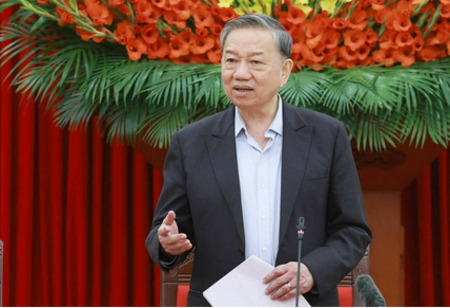
Party General Secretary and State President To Lam urged substantial reforms in infrastructure planning and development, highlighting that infrastructure is a crucial element in boosting national competitiveness and should be planned and managed with a long-term strategic perspective.
Leading a working session with the Government Party Committee and pertinent agencies in Ha Noi, the chief leader assessed the execution of Resolution No. 13-NQ/TW, released by the 11th Party Central Committee in 2012, along with Conclusion No. 72-KL/TW of the 13th Politburo regarding the creation of a coordinated infrastructure system to assist Viet Nam in becoming a modern industrial nation.
Also Read: LG Uplus Acquires Cybersecurity Firm for AI Security Abilities
In his final comments, the leader emphasized that infrastructure is no longer just a base for production and everyday activities, but has evolved into a crucial element in boosting national competitiveness. The evaluation of infrastructure must be based on the concrete advantages it provides to individuals, companies, and the economy.
Highlighting deficiencies in infrastructure development, President Lam and the General Secretary urged for improved coordination between planning and investment, with infrastructure initiatives aimed at optimizing service quality and economic efficiency while promoting balanced growth of physical, digital, and natural infrastructure.
He stressed that infrastructure needs to be regarded as a vital economic sector, capable of promoting a significant domestic market for production and innovation, with the government leading efforts to mobilise resources and channel public investment into crucial, inter-regional, and impactful projects.
Emphasizing important tasks for the upcoming period, he urged the Government Party Committee to focus on reforming planning and advancing infrastructure development. He stated that infrastructure planning should be in harmony with the nation's long-term development strategy, economic spatial planning, and initiatives to boost national competitiveness. It must consider advancements in technology, market dynamics, shifts in demographics, and climate change while promoting stronger connections between sectors, regions, and economic zones.
Similarly, he urged for synchronized advancement of economic, social, and digital infrastructure in conjunction with scientific, technological, and innovation infrastructure, while enhancing connectivity among transport, energy, logistics, urban development, and various socio-economic infrastructure systems.
Also Read: Emirates NBD Expands Egypt Footprint with HSBC Banking Deal
Infrastructure planning needs to enhance connectivity among regions, urban and rural spaces, as well as domestic and international markets, while incorporating objectives for national defence, security, environmental protection, digital transformation, and green transition.
He stressed enhancing regional financial coordination systems to enable localities to collectively fund, oversee, and gain advantages from infrastructure projects spanning multiple regions.
General Secretary and President Lam additionally urged for a comprehensive reform of investment management and governance of infrastructure assets, emphasizing increased accountability for agency leaders.
Also Read: WeRide Expands European Footprint with Denmark Robotaxi Launch Plans
He emphasized that project preparation and execution must enhance lifecycle management, asserting that investment choices should be finalized only after ensuring that land, capital, construction materials, technology, human resources, and associated infrastructure are thoroughly ready.