


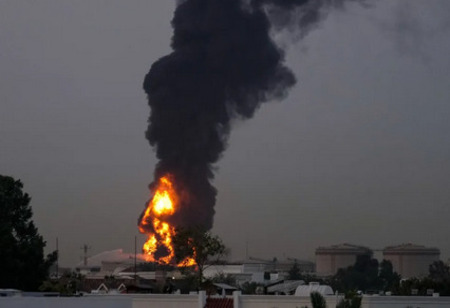
Iran ignited a significant natural gas field in the United Arab Emirates in an effort to increase attacks on critical energy facilities.
Meanwhile, President Donald Trump called on allies and countries like China to assist in the reopening of the Strait of Hormuz.
The recent drone strike at the Shah field, located near the border of the United Arab Emirates (UAE) and Saudi Arabia, represents a significant event as it signifies the initial instance where Iran has targeted an oil or gas upstream facility within the nation throughout the conflict.
Also Read: Indonesia Boosts Energy Self-Sufficiency through Bioenergy
Following the attack, the UAE authorities confirmed a temporary halt in operations at the field, which is a collaborative project between the Abu Dhabi National Oil Company and Occidental Petroleum Corp, a company based in Texas.
The UAE closed its airspace abruptly in response to multiple drones and missiles approaching the region. Officials confirmed that aviation activities had resumed without incident by the following Tuesday morning.
Also Read: Lee Urges Calls for Close Monitoring of Gas Stations
These attacks occurred in the aftermath of Iran's strike on a fuel tank at Dubai's primary airport, a major global transit hub, resulting in a significant cloud of smoke engulfing the city and temporary disruptions to flight schedules. The ongoing conflict, now entering its 18th day, displays minimal indication of diminishing.
Iran persists in launching drones and missiles at Arab nations in the Persian Gulf as well as Israel, affirming their disinterest in engaging in discussions for a ceasefire.
The US and Israel persist in carrying out daily assaults on Iranian installations, including those within the capital city of Tehran. Furthermore, Israel is intensifying its military activities in Lebanon, where they are engaged in a simultaneous conflict with the Iran-aligned Hezbollah militia.
According to reports, the death toll in the Middle East has exceeded 4,000. The Human Rights Activists News Agency, based in the US, has reported approximately 3,100 fatalities in Iran, with the Lebanese government confirming 850 deaths as a result of Israeli airstrikes.
Also Read: Ministry Aims Strong Women's Political Education, Representation
Additional casualties have been recorded in Gulf states, Israel, and the United States, where 13 military personnel have been killed. Oil prices have remained stable throughout the current week, hovering at approximately $104 per barrel.
However, following the commencement of hostilities, these prices have significantly increased, alongside escalating costs for liquefied natural gas, fertilizers, aluminum, and various other commodities. This surge can largely be attributed to the decisive blockage of the strategically important Hormuz strait, situated between Iran and Oman. The strait serves as a critical maritime route, facilitating the transportation of roughly one-fifth of the global oil and LNG quantities.