


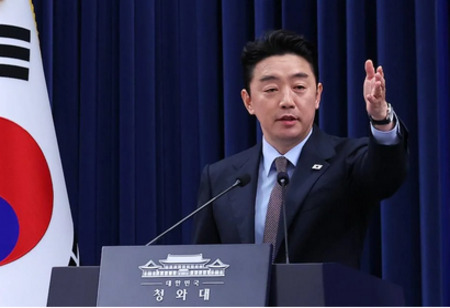
Hoon-sik Kang, the Chief of Staff for the President, paid a visit to the United Arab Emirates where he reached an agreement to promptly procure an extra 18 million barrels of crude oil.
Additionally, the two nations have decided to enter into a formal agreement regarding cooperation in the oil supply chain.
“In the midst of a global oil supply emergency, the UAE promised to supply crude oil to South Korea as its top priority”, Kang says.
Also Read: SK Group Chairman Says Wafer Shortage to Last Until 2030
“They clearly pledged that 'no country will receive oil before South Korea' and that 'South Korea is the number one priority for oil supply”.
After serving as a presidential special envoy for strategic economic cooperation in the UAE, Kang relayed during a briefing at Cheong Wa Dae that the special envoy delegation engaged in discussions regarding concrete cooperation measures aimed at strengthening trust with the UAE, a long standing friend and important ally, and offering assistance during the current crisis amidst escalating tensions in the Middle East.
Kang elaborated on the agreement between the two nations for the emergency import of 18 million barrels of crude oil across multiple procurement sources. He specified that three UAE-flagged vessels will provide six million barrels, while six South Korean-flagged vessels will supply the remaining 12 million barrels.
Also Read: Viet Nam Places Top Priority on Ties With China: PM
Additionally, he mentioned that a vessel carrying naphtha is currently making its way to South Korea. The South Korean government had previously established an emergency acquisition of 6 million barrels of crude oil from the United Arab Emirates. When combined with the supplemental procurement obtained by the special envoy delegation, the overall quantity totals 24 million barrels.
“This agreement in the energy sector is expected to significantly contribute to stabilizing the oil supply crisis," Kang said. "The two countries agreed to strengthen cooperation not only on short-term supply but also on long-term supply to prepare for disruptions in the energy supply chain”.
He added that “the two countries agreed to sign an MOU on oil supply chain cooperation that includes exploring alternative supply routes for crude oil, and the signing is expected to take place soon”.
Furthermore, a recent poll revealed that fifty percent of bond market analysts in South Korea anticipate an increase in consumer prices in the coming month. This projection is attributed to the anticipated impact of the potential closure of the Hormuz Strait due to the prevailing crisis in the Middle East, which is expected to contribute to inflationary pressures. A recent survey conducted by the Korea Financial Investment Association (KOFIA) among 100 bond market experts revealed that half of the respondents anticipate an increase in consumer prices during the month of April.
Additionally, 35 percent of survey participants anticipated a continued depreciation of the Korean won in relation to the American dollar. The domestic currency experienced a significant depreciation, reaching its lowest point since March 10, 2009. This decline was attributed to the conflict in the Middle East, causing the currency to momentarily breach the 1,500-won mark, a level considered both psychologically and technically crucial, for the first time in 17 years.
Also Read: Science Ministry Offers Water Management Aid to Mekong Nations
According to a growing number of experts, it is anticipated that bond yields will increase in April, due to the Bank of Korea's inclination to maintain the nation's base rate at a consistent level for an extended duration, given the ongoing turmoil in the Middle East and the depreciation of the domestic currency. KOFIA stated that the Bond Market Survey Index (BMSI) for April experienced a decrease to 90.5, marking a decline of 5.7 points compared to its March level of 96.5. A BMSI score below 100 indicates a heightened anticipation among industry experts for a deterioration of bond market conditions.