


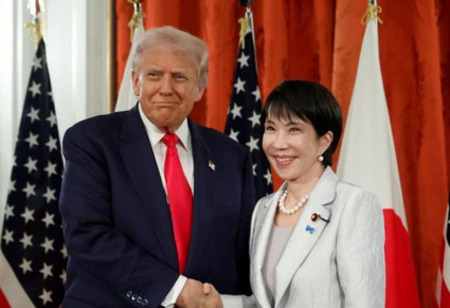
The US and Japan have revealed a new strategic minerals initiative designed to enhance the resilience of supply chains, with a particular emphasis on promoting collaboration in the field of deep-sea mining.
The agreement outlines a structure for enhanced collaboration on trade policy, supply chain security, and the exploration of alternative sources of critical minerals, as both nations aim to lessen their dependence on limited global supply.
Also Read: Viet Nam Places Top Priority on Ties With China: PM
The initiative was described by US Trade Representative Ambassador Jamieson Greer as a measure towards expanding the variety of supply options available.
“The United States and Japan are taking an important step to expand the production and diversity of critical minerals, laying the foundation for a binding plurilateral agreement supported by price floors and other measures,” he says.
An essential aspect of the agreement involves a recent memorandum of cooperation aimed at expediting collaborative research and development efforts towards the extraction of economically feasible deep-sea mineral resources, specifically those abundant in rare earth elements.
The two nations will prioritize the exploration of deposits in the vicinity of Japan's Minamitorishima Island, which is known to contain rare-earth muds with substantial supply potential for industrial use in the long term.
The action plan also outlines strategies for creating strategic trade policies and implementing border mechanisms to reduce supply disruptions and safeguard downstream industries that rely on imported critical minerals.
The program is an extension of larger regional endeavors to enhance energy and resource stability, as evidenced by the Indo-Pacific Energy Security Ministerial and Business Forum, where over $50 billion in projects and investments were emphasized by leaders.
Also Read: South Korea Holds Early Talks With Anthropic to Expand AI Ties
Both nations stated that the agreement would facilitate the establishment of reliable supply chains for vital minerals required by important industries such as energy, advanced manufacturing, and infrastructure, while also strengthening collaboration within the Indo-Pacific alliance network.
The plans for the development of small modular reactors by GE Vernova Hitachi in Tennessee and Alabama were jointly announced by the two governmental bodies, with an anticipated budget of $40 billion. The GE Vernova Hitachi is a collaborative effort established between the multinational corporation known as General Electric and the prominent Japanese conglomerate Hitachi.
Also Read: Saudis Give Oil Buyers Red Sea Option as Hormuz Crisis Persists
The governments have additionally unveiled intentions to build natural gas generation facilities in Pennsylvania with an approximate cost of $17 billion and in Texas with a cost of up to $16 billion. These projects are intended to assist in stabilizing electricity prices for the American population and provide power to data centers. These projects mark the second round of announcements following Japan's pledge to invest $550 billion in the US as a means of gaining relief from the tariffs imposed by the US president last year.
The nations also exchanged the draft of a memorandum of understanding regarding the creation of a collaborative initiative between Japan and the US aimed at enhancing the progress of deep-sea mineral resource extraction. This initiative is intended to facilitate the exchange of data pertaining to deep-sea research and projects involving seabed mineral resources, with a particular focus on Japan's initiatives such as the rare-earth muds project near Minamitorishima Island and the polymetallic nodules project, to explore opportunities for mutual cooperation.