


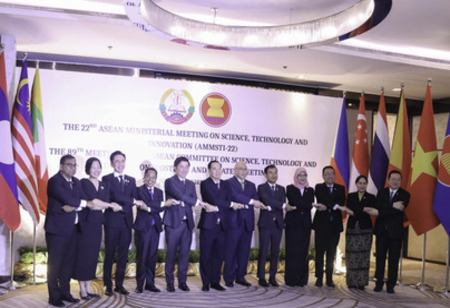
Vietnam reiterated its dedication to promoting regional cooperation during the 22nd ASEAN Ministerial Meeting on Science, Technology and Innovation (AMMSTI-22) that took place in Vientiane, Laos, on June 26.
The gathering, focused on "Advancing ASEAN Plan of Action on Science, Technology and Innovation (APASTI) for a Resilient, Sustainable and Competitive ASEAN," convened ministers and officials from ASEAN member countries along with ASEAN Secretary-General Kao Kim Hourn to explore ways in which science, technology, and innovation can enhance the bloc's resilience, competitiveness, and sustainable growth.
Also Read: Undana, ATSEA Partner to Study Dugongs to Support Blue Economy
The Vietnamese team, headed by Deputy Minister of Science and Technology Bui Hoang Phuong, presented several proposals to enhance regional collaboration.
During the meeting, Phuong articulated Vietnam's endorsement of the ASEAN initiative, highlighting science, technology, innovation, and digital transformation as pivotal forces for sustainable development throughout the region. Leveraging Vietnam's development experience, he suggested broadening collaborative research initiatives in key areas of mutual interest, such as water security, climate-resilient advanced agriculture, and the shift towards green energy.
The Deputy Minister emphasized the importance of cultivating a highly-skilled labor force by enhancing connections among top ASEAN universities and research centers and facilitating expert exchanges to bridge technology disparities in the region. Vietnam urged for increased collaboration and the creation of shared regional frameworks for emerging strategic technologies like artificial intelligence (AI), big data, space technology, and cybersecurity to foster a safe digital business environment and boost ASEAN's overall competitiveness.
Also Read: Gaon Cable Lands First Global EV Supply Chain Deal
A key result of the meeting was the approval of a substantial reorganization of the ASEAN Committee on Science, Technology and Innovation (COSTI), decreasing its sub-committee structure from nine to five specialized groups to optimize governance, strengthen alignment with APASTI, and expedite the execution of regional priorities.
The meeting also acknowledged advancements on two Priority Economic Deliverables for 2026: an ASEAN declaration focused on enhancing collaboration in space science, technology, and innovation, along with a regional initiative for AI applications in healthcare.
Delegates introduced the ASEAN Science, Technology and Innovation Fund (ASTIF) Call for Proposals focusing on the theme "ASEAN Grand Challenge: AI-Enabled Competitive and Resilient Region," which seeks to utilize artificial intelligence to tackle regional issues, stimulate innovation, and enhance the wellbeing of individuals.
They also embraced the operational launch of the ASEAN–Republic of Korea High-Performance Computing Facility in Indonesia, the region's initial collaborative supercomputing infrastructure, anticipated to aid advanced research in AI, climate modeling, disaster prediction, biotechnology, and industrial innovation.
Also Read: MoF Proposes Extending Tax Relief to Curb Inflation Risks
The meeting ended with the approval of a joint media statement reaffirming ASEAN's dedication to enhancing regional STI collaboration and alliances with dialogue partners to create a more resilient, sustainable, and competitive ASEAN. Malaysia is set to welcome the 23rd ASEAN Ministerial Meeting on Science, Technology, and Innovation in June 2027.