


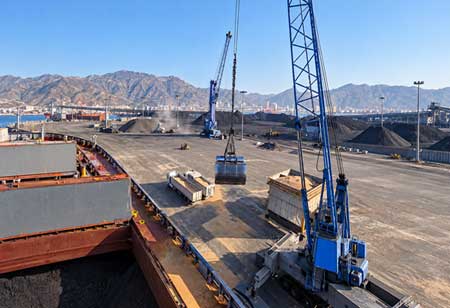
Mining projects are usually evaluated through the quality of the deposit, expected production volumes, processing costs, infrastructure requirements and commodity prices. Ocean transportation is often considered much later, when production is approaching and the first export cargo needs to be sold.
That sequence can be expensive.
For a mining project that depends on international buyers, maritime logistics should be assessed before production begins. The location of the mine, available ports, expected shipment sizes, cargo characteristics and suitable vessel types can directly influence the project’s commercial viability.
A mineral deposit may be attractive, but the export model can become uncompetitive if the nearest port cannot accommodate the required vessels, the cargo must be moved over a difficult inland route or small shipment sizes produce disproportionately high freight costs.
Ocean transport is therefore not simply the final stage of the supply chain. It is part of the project’s economic structure.
Freight costs can change the value of the product
The cost of shipping dry bulk commodities depends on more than the distance between the loading and discharging ports.
The final freight rate may be influenced by:
- Cargo quantity
- Stowage factor
- Loading and discharging rates
- Port draught restrictions
- Availability of suitable vessels
- Seasonal weather conditions
- Vessel positioning
- Bunker prices
- Port congestion
- Cargo-handling requirements
- Trade restrictions and insurance conditions
A project financial model that uses a general freight assumption without considering these factors may significantly underestimate the cost of reaching the buyer.
The difference between shipping 10,000 tonnes and 30,000 tonnes is not merely a larger total freight bill. A bigger parcel may provide a lower freight cost per tonne because the vessel’s voyage expenses are distributed across more cargo. However, the port, stockpile and inland transport system must be capable of assembling and loading the larger quantity within an acceptable period.
If the mine can produce only small monthly parcels, or if the port has limited storage capacity, the exporter may be forced to use smaller vessels. Such vessels can be operationally suitable but more expensive on a per-tonne basis, particularly on long-distance routes.
Professional dry bulk cargo chartering should therefore be incorporated into the project’s financial assessment before sales commitments are made.
Port selection is more than choosing the nearest terminal
The closest port is not always the most economical export gateway.
A port may appear suitable on a map but have restrictions that prevent the use of the vessel size required by the commercial model. These restrictions may concern:
- Maximum permissible draught
- Length overall and beam
- Air draught
- Turning-basin dimensions
- Berth strength
- Channel depth
- Night navigation
- Tug requirements
- Seasonal limitations
- Shore-crane capacity
- Environmental permits
The terminal’s actual loading performance is equally important. A slow loading rate increases the vessel’s time in port and is normally reflected in the freight calculation. If the agreed loading rate is not achieved, the exporter may also face demurrage.
A more distant port with better infrastructure, deeper water and faster loading can sometimes produce a lower total transport cost than a nearby restricted terminal.
The port must also have sufficient storage capacity. Mining production is continuous, while vessel arrivals occur at intervals. If the exporter cannot accumulate a complete cargo before the vessel arrives, the ship may wait while production continues. This can create substantial additional costs and disrupt future shipments.
Shipment size must match production reality
Mining companies naturally want to benefit from the lower unit costs associated with larger vessels. However, the intended shipment size must correspond with actual production, inland transport and storage capacity.
A vessel should not be fixed on the assumption that the required cargo will somehow become available by the laycan. Before entering the freight market, the exporter should establish:
- The daily and monthly production rate
- Existing stock available for shipment
- Inland delivery capacity
- Port storage limitations
- Expected cargo losses and moisture variation
- Time required for sampling and certification
- Customs and export-documentation procedures
- The terminal’s realistic loading rate
An ambitious sales programme may call for large and frequent shipments, but the vessel schedule cannot be based solely on annual production targets. Each cargo requires a realistic readiness date supported by the mine, inland carrier, port and terminal.
If the cargo is not ready when the vessel arrives, the expected freight saving from using a larger ship can quickly disappear through waiting time, demurrage or cancellation costs.
Cargo characteristics influence vessel selection
Not all mineral cargoes can be treated in the same way.
Bulk density and stowage factor determine how much space the cargo will occupy. Moisture content can affect handling, stability and regulatory requirements. Some products create significant dust, while others may be corrosive, abrasive or prone to contamination.
Accurate cargo information is essential before requesting firm freight offers. The enquiry should identify the exact commodity, quantity, loading and discharging ports, laycan, loading rates and any special handling requirements.
Owners may also request supporting documentation, including cargo declarations, safety information and test certificates. Late disclosure of material cargo characteristics can lead to the withdrawal of a vessel, additional conditions or an increased freight rate.
Vessel suitability should consequently be evaluated against the actual cargo rather than a general description such as “ore,” “mineral concentrate” or “industrial material.”
Export projects may require more than bulk transportation
A mining project normally needs substantial equipment before it can produce export cargo.
Crushers, screens, mills, transformers, excavators, processing modules and other heavy components may have to be transported to the project site. Their dimensions and weights can exceed the limits of container shipping and require breakbulk or heavy-lift vessels.
This creates two connected maritime requirements:
- The inbound transportation of machinery and project cargo during construction.
- The outbound shipment of mineral products after production begins.
These activities are frequently planned by different teams, although they depend on much of the same infrastructure. A port that can load bulk minerals may not have the cranes, quay strength or space required to receive oversized equipment. Conversely, a project-cargo terminal may not be capable of storing and loading large bulk parcels.
Early project cargo chartering analysis helps determine whether heavy equipment can reach the project through the intended port and whether an alternative gateway or specialised vessel will be required.
Long-term production does not guarantee vessel availability
A mine may operate for decades, but vessels are fixed for specific dates and voyages.
Unless a dedicated contract of affreightment or consecutive-voyage arrangement is commercially justified, each shipment may need to compete for tonnage in the open freight market. The available vessel is determined by its position, open date, previous employment and expected next voyage.
A long-term production programme does not automatically give the exporter priority access to suitable ships. Market conditions may change considerably between shipments. Rates can rise because of stronger demand, limited regional vessel availability, port congestion, bunker-price movements or geopolitical disruption.
Exporters should therefore test different freight-market scenarios rather than rely on one fixed assumption. The model should consider how the project performs under both favourable and difficult shipping conditions.
It is also useful to identify several commercially workable shipment sizes. Flexibility between different vessel categories can increase the number of available ships and reduce dependence on a narrow segment of the market.
Sales contracts and shipping plans must support each other
A mineral sales contract can create obligations that the physical logistics cannot fulfil.
Before agreeing delivery terms, shipment periods or minimum quantities, the seller should confirm that the required vessels can enter both ports and that the cargo can be made ready within the contractual period.
The choice between FOB, CFR and CIF terms also changes the seller’s responsibilities. Under an FOB sale, the buyer generally arranges the vessel, but the seller remains responsible for making the cargo available and meeting the agreed loading conditions. Under CFR or CIF terms, the seller must also arrange ocean transportation.
If the sale contract and charter party are negotiated separately without coordination, inconsistencies can arise. The seller may promise a loading rate that the terminal cannot achieve or accept a shipment window that does not allow sufficient time to assemble the cargo.
Shipping expertise should therefore be involved before the sales terms become binding.
The lowest freight indication may not be the best option
A low freight indication is attractive, but it should not be evaluated in isolation.
A cheaper vessel may have unsuitable hold dimensions, limited cargo intake because of draught restrictions or operational requirements that create additional port costs. It may also come from an owner with insufficient experience in the relevant trade.
The correct comparison is the total expected cost of delivering the cargo, including:
- Ocean freight
- Inland transportation
- Storage and handling
- Port charges
- Survey and documentation costs
- Expected loading time
- Demurrage exposure
- Cargo loss and contamination risk
- Financial consequences of delay
The most economical vessel is the one that can complete the voyage reliably under the actual conditions of the project.
Maritime planning belongs in the feasibility study
Ocean transport planning should begin while the mining project still has the flexibility to change its logistics model.
A preliminary shipping study can identify suitable ports, realistic parcel sizes, vessel categories, loading requirements and indicative freight ranges. It can also reveal infrastructure improvements that may reduce transportation costs throughout the life of the mine.
Early analysis provides investors and project developers with a more accurate understanding of the delivered cost of the product. It also reduces the risk of discovering after production begins that the intended export route is operationally restricted or commercially uncompetitive.
A mining project does not end at the mine gate. If its product is destined for international buyers, the project extends through the inland route, storage terminal, loading berth, ocean voyage and discharge port.
The earlier these elements are evaluated as one transport system, the more reliable the project’s commercial assumptions will be.

About the author
Konstantin Kalnyi is the CEO and Founder of Kiev Shipping Ltd and an independent shipbroker with more than 25 years of experience. Established in 2000, Kiev Shipping Ltd provides international ship chartering, maritime brokerage and commercial ship management services for dry bulk, breakbulk and project cargoes.