

.png)
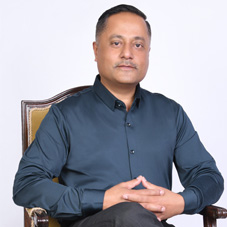
Roshan Soti
Chief Executive Officer
In today's rapidly evolving industrial landscape, the role of a Chief Executive Officer extends far beyond overseeing operations. Successful CEOs establish a long-term vision, foster innovation, develop resilient teams, and create an organizational culture that balances technical excellence with commercial sustainability.
Particularly in infrastructure-driven sectors such as hydropower, where projects demand precision, collaboration, and long-term planning, strong leadership becomes a critical catalyst for sustainable growth and national development. Among the leaders shaping Nepal's engineering landscape is Roshan Soti, Chief Executive Officer of Nepal Hydro & Electric Limited.
With nearly three decades of professional experience, Soti's journey reflects steady progression built on technical expertise, continuous learning, and an unwavering commitment to the country's hydropower sector.
He completed his early education in Nepal before moving to India, where he pursued his Intermediate Science (ISC) and earned his engineering degree. Recognizing the growing importance of business leadership alongside technical competence, he later strengthened his managerial capabilities by completing an Executive MBA between 2008 and 2010 AD.
Soti began his professional career in 1996 with a company in Chennai before returning to Nepal to work in the pulp and paper industry. In 2000, he joined Nepal Hydro & Electric as a Mechanical Engineer - a decision driven by his conviction that hydropower represented one of Nepal's most promising industries with the potential to contribute meaningfully to the nation's long-term development.
Over the years, he steadily advanced through the organization, serving as Senior Engineer, Manager of the Mechanical Division, Deputy General Manager (Technical), overseeing the company's mechanical, electrical, and service divisions, and later as Deputy CEO.
In December 2020, he assumed the role of Chief Executive Officer, bringing together decades of engineering expertise, operational excellence, and strategic leadership to guide Nepal Hydro & Electric's continued growth and contribution to Nepal's evolving energy sector. Let’s dive in to know more.
Throughout your career, what achievements are you most proud of, and how have they shaped your expertise in hydro-mechanical and electro-mechanical engineering?
I have never believed that a single achievement defines a career. Every experience, challenge, and responsibility has contributed to my professional growth. Over the past 25 years at Nepal Hydro & Electric, I have worked across engineering design, product development, risk management, industrial relations, and international joint ventures.
Solving complex technical, contractual, and managerial challenges has strengthened my expertise while teaching me the value of teamwork, disciplined execution, and timely decision-making. Above all, I take pride in mentoring young engineers because I believe developing future leaders is as important as delivering successful projects.
Having witnessed the evolution of Nepal's energy landscape firsthand, what major industry changes have had the greatest impact on the development of the hydropower sector?
The biggest transformation has been Nepal's economic liberalization, which opened the hydropower sector to private investment. This shift accelerated project development, and today private developers contribute more than 80% of the country's electricity generation.
Government support for public-private partnerships and the BOT/BOOT model has further strengthened investment. Expanded transmission networks and cross-border electricity trade with India and Bangladesh have also improved the sector's commercial viability.
While challenges such as land acquisition, environmental approvals, and policy coordination remain, I believe stronger collaboration among stakeholders will continue driving sustainable growth.
Engineering projects often require balancing innovation with practicality. How do you evaluate new technologies and solutions while ensuring reliability, safety, and long-term performance?
I believe innovation should always be practical and purposeful. It is not simply about adopting new technologies but about finding better ways to improve efficiency, safety, and long-term performance. I evaluate every solution based on its technical reliability, operational benefits, economic viability, and contribution to sustainable resource utilization.
Even small improvements can significantly enhance project outcomes. As an engineer, I ensure that every technological decision is backed by sound engineering principles while remaining practical, cost-effective, and capable of delivering long-term value.
Infrastructure development extends beyond technical execution. In your view, what role does engineering leadership play in supporting economic growth and national development?
Engineering leadership is about creating infrastructure that delivers lasting economic and social value. Beyond technical excellence, leaders must uphold integrity, accountability, innovation, and ethical decision-making. In Nepal, reliable energy infrastructure is essential for industrial growth, attracting investment, generating employment, and strengthening energy security.
I also believe leadership involves mentoring future professionals and fostering a culture of continuous learning. Ultimately, engineering leaders have the responsibility to deliver projects safely, sustainably, and efficiently while building assets that contribute to national development for generations to come.
As engineering projects become increasingly complex, how do you encourage knowledge sharing, technical excellence, and future leadership development within your teams?
I believe technical expertise alone is no longer enough. Today's engineers also need managerial capabilities, financial awareness, and a broader understanding of project delivery. At Nepal Hydro & Electric, we promote a collaborative culture through technical discussions, project review meetings, and lessons-learned workshops, where teams openly share experiences and best practices.
Continuous learning is an integral part of our work environment. I firmly believe that achievement is built through teamwork, trust, and shared commitment, it is not a single-handed miracle. Company is a perennial entity, developing future managers/leaders are equally important.
By encouraging knowledge sharing and mentoring young professionals, and fostering corporate culture & Path-Goal type leadership, we strengthen technical excellence while preparing the next generation of engineering leaders to manage increasingly complex projects.
As someone wisely said, buildings, machines and capital create capacity but people create the excellence. Ultimately, organization succeeds when it develops its human resources.
Roshan Soti, Chief Executive Officer, Nepal Hydro & Electric
Roshan Soti is the Chief Executive Officer of Nepal Hydro & Electric, with nearly three decades of experience in hydro-mechanical and electromechanical engineering. Having joined the company in 2000 as a Mechanical Engineer, he has risen through the ranks to lead the organization, driving technical excellence, innovation, and sustainable hydropower development in Nepal.