


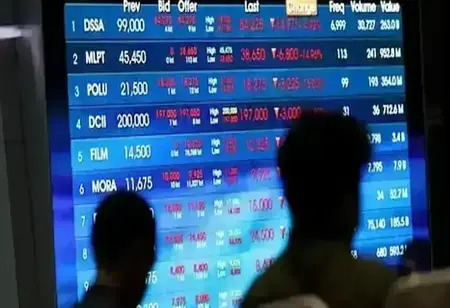
Uncertainty around President Donald Trump's impending Iranian conflict deadline sent the financial markets swinging, as tentative ceasefire signals were balanced out by fears of increased violence in the area.
The price of Brent crude oil fell from its initial rise to settle at just under $110 per barrel as the volatility in the markets before Trump’s deadline for action continues. US index futures came back from their early losses and ended up about unchanged from yesterday's close.
The MSCI Asia Pacific Index was up 0.7 percent this morning following strong gains from South Korea. The companies that benefited the most were those in the technology sector, which has not been impacted as much by the ongoing conflict in the Middle East.
Samsung Electronics Co., for example, increased by 1.5 percent on news that profits rose eightfold in the last quarter compared to a year ago.
Trump said talks with Iran are “going well” ahead of the deadline to agree to a deal, even as he insisted that freedom of navigation through the Strait of Hormuz must be part of any accord. If Iran doesn’t agree to the US’s terms, the military may destroy “every bridge in Iran by 12 o’clock tomorrow night” and put every power plant “out of business,” Trump said.
“It’s clearly too early for market watchers to stop thinking about geopolitical risk,” said Jeff Buchbinder at LPL Financial. “For now, we believe the best course of action for investors is to be patient.”
Iran reportedly passed to mediator Pakistan a rejection of a ceasefire proposal. It demanded a permanent end to the war, lifting of sanctions, and reconstruction efforts, in addition to protocol for safe passage through Hormuz, according to the report.
While traders kept a close eye on geopolitical developments, they awaited this week’s key inflation readings. Data published Monday showed the US service economy expanded in March at a slower pace as employment shrank by the most since 2023 and input prices accelerated.
The mixed economic signals illustrate the uncertain time for most businesses, according to Jeff Roach at LPL Financial.
“A prolonged struggle over the Strait of Hormuz into May and June would markedly darken the outlook for the US and the global economy,” he said. “For now, given last Friday’s payroll numbers, Fed policymakers have the luxury of remaining in ‘wait and see’ mode,” he added.
Also Read: Xi’s Red Line on Trump’s Export Curbs Threatens to Upend Truce
While investors have been fixated on geopolitical risks, the macro data continues to point to a resilient economy and a still-constructive earnings outlook, according to Mark Hackett at Nationwide.
Also Read: Lee Eog-weon Becomes First and Last FSC Chairman
Systematic investors are poised to flip back into equity-buying mode after slashing their exposure to multi-year lows during the recent market selloff, according to Goldman Sachs Group Inc.’s trading desk.
Also Read: Ether surges nearly 25% for its best week in four years.
“We believe the S&P 500 is carving out a low and think it makes sense to start adding length in cyclical and quality growth trades where earnings remain strong, valuation has compressed, and sentiment is negative,” said Michael Wilson at Morgan Stanley.