


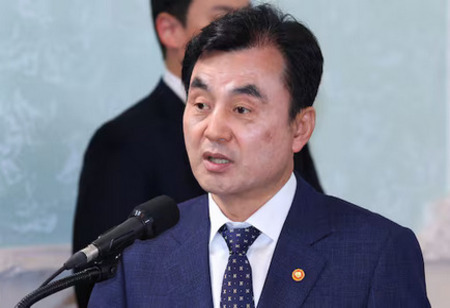
Defense Minister Ahn Gyu-back announced the government's plans to proceed with a comprehensive overhaul of the military in response to an impending manpower shortage resulting from the decreasing birth rate in the country.
Ahn mentioned at a press conference in Seoul that the Ministry of National Defense is in the process of reshaping the military's organization, including its force, units, and personnel, as part of a thorough reform plan.
The reform plan is anticipated to be completed later this year, subsequent to a defense reform seminar and formal Cabinet evaluation, with presidential endorsement aimed for the third or fourth quarter.
Also Read: Strong Leadership, Systemic Reform Could Combat Corruption: Azam
Ahn pointed to the rapid evolution of modern warfare as another significant catalyst for the restructuring. He mentioned the trend towards asymmetric warfare, in which cost-effective drones have the capability to counter high-priced, sophisticated weapons. He utilized demographic information to demonstrate the magnitude of the problem.
As stated by Ahn, the volume of infants born in 2023 was approximately 118,000. Based on the existing conscription arrangement, this would equate to roughly 160,000 draftees in the near future, marking a significant decline from the 220,000 reported in 2025. The ministry intends to implement a "selective recruitment system" to address the issue, all the while upholding the current conscription structure.
This system will enable conscripts to move into technical noncommissioned officer positions as they serve their duty. Ahn stated that the focus is not on eliminating conscription but rather on establishing a route for individuals in the military to advance as skilled noncommissioned officers, specifically in sectors reliant on technology.
The goal of the ministry is to recruit approximately 50,000 individuals with the ability to operate advanced weaponry and smoothly transition into roles in the civilian workforce, establishing a beneficial relationship between the military and the private sector, as described by Ahn.
The military intends to decrease the quantity of soldiers designated for frontline defense duties and place greater emphasis on utilizing surveillance systems based on artificial intelligence as well as mobile response units. Additionally, there are plans to privatize a larger portion of security operations for rear-area bases and transfer responsibility for coastal surveillance to the Coast Guard.
Also Read: IMF Chief Says Iran War Means 'All Roads' Lead to Higher Prices
Ahn stressed the importance of enhancing the circumstances for junior officers to maintain the effectiveness of the military. He conveyed that a military profession goes beyond being merely a job and instead is a public obligation that entails putting one's life at risk for the nation. The ministry is collaborating with financial authorities to enhance remuneration and benefits in line with or exceeding those provided by medium-sized corporations.
It is anticipated that annual salaries for staff sergeants will climb to approximately 40 million won ($27,000), and senior noncommissioned officers could potentially earn between 60 million and 70 million won. The minister further discussed the ongoing dialogues with the US regarding nuclear-powered submarines, noting the keen interest of the U.S. to swiftly progress in this matter.
Also Read: Defense Minister Praises Growing Military Ties With China
Ahn also mentioned that a relevant meeting is anticipated to occur later this month. He observed that Korea intends to construct the submarine hull within its own borders with assistance in the form of nuclear fuel from the US, a strategy that he pointed out contrasts with agreements like AUKUS, a trilateral security partnership involving the U.S., the UK, and Australia.