


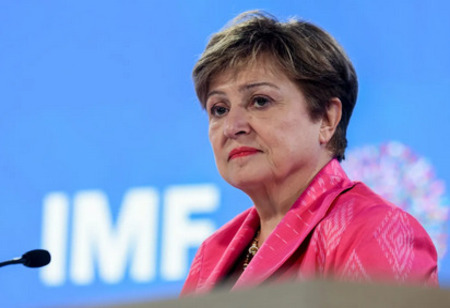
The head of the International Monetary Fund stated that the military conflict between the US and Israel against Iran will result in increased inflation and a decline in global economic growth.
This announcement came before the global lender's upcoming projection for the world economy next week.
The conflict has led to severe disruptions in the global energy supply, causing the closure of numerous oil production facilities as a result of Iran's successful blockade of the strategically important Strait of Hormuz, through which a significant portion of the world's oil and gas is transported.
Also Read: UAE Says Use of Hormuz Must be Guaranteed in Any US-Iran Deal
Despite being resolved quickly, the IMF is expected to lower its economic growth forecast and raise its inflation outlook, as stated by Kristalina Georgieva, the managing director of the IMF.
At next week's spring meetings of the IMF and World Bank in Washington, finance officials from various countries are anticipated to engage in discussions primarily centered around the impact of the ongoing war.
The Fund is anticipated to present various scenarios in its forthcoming World Economic Outlook scheduled for release on 14 April. In a blog post on 30 March, it hinted at a potential revision downward, attributing it to the disproportionate impact of the war and more stringent financial circumstances.
Georgieva stated that in the absence of the conflict, the IMF had anticipated a modest increase in its forecast for worldwide economic growth, with a projection of 3.3 percent for 2026 and 3.2 percent for 2027, reflecting ongoing recovery efforts from the pandemic.
"Instead, all roads now lead to higher prices and slower growth," says Georgieva, who will preview the spring meetings in a speech. World Bank President Ajay Banga will present his view at an Atlantic Council event.
Also Read: Indonesia Can be Korea’s Energy Hedge: Commerce Chamber Head
According to Georgieva, the global oil supply has decreased by 13 percent due to the war, causing a ripple effect on oil and gas deliveries as well as related supply chains, including helium and fertilizers. She stated that even if hostilities were to cease quickly and there was a swift economic recovery, there would only be a modest downward adjustment to the growth projection and an upward adjustment to the inflation projection.
In the event of a prolonged conflict, the impact on inflation and growth would be more significant. Georgieva emphasized that low-income and fragile nations lacking energy reserves will bear the brunt of the impact. She observed that numerous countries are facing limited to no financial flexibility to assist their citizens in enduring the surge in prices resulting from the conflict, consequently heightening the risk of civil unrest.
Georgieva stated that several nations had requested financial assistance, without specifying which ones. She mentioned that the IMF could enhance current lending initiatives to address the requirements of these countries. The majority of the IMF's members, approximately 85 percent, rely on imported energy sources.
Also Read: Malaysia's Palm Oil Sector in Advantageous Position
She expressed that providing extensive energy subsidies was not the solution, and emphasized the importance of policymakers refraining from implementing government payments that may exacerbate inflationary pressures. The repercussions have not been evenly distributed, with a more pronounced impact on nations reliant on energy imports, although even countries that export energy like Qatar are experiencing the consequences of Iranian attacks on their production sites.
According to Georgieva, Qatar anticipates a three to five year timeline for the restoration of 17 percent of its natural gas production following the damages incurred. Additionally, the International Energy Agency has identified 72 energy facilities as being impacted by the conflict, with a third of them experiencing substantial levels of damage.