


Hyundai Glovis, the logistics and distribution subsidiary of Hyundai Motor Group, is launching an organized initiative to integrate artificial intelligence tools into everyday functions throughout its business sectors.
The company announced that it had just finished the initial cohort of its AI Boot Camp, a six-week internal training program where staff from all departments utilized AI agents and coding tools to address actual workplace enhancement projects.
Participants advanced past concept presentations, delivering concrete outcomes in data analysis and process reengineering.
A member from the car carrier division — responsible for transporting finished vehicles over water — created an operations portal utilizing vibe coding, a method where a user articulates a task in simple language and AI produces the corresponding code. The portal integrates shipping route information, port facility details, and cargo-handling cost estimates that once necessitated searching through various databases.
An individual from the used car department utilized a similar method to create a vehicle recommendation system for customers. The tool categorizes purchasers according to their budget, desired vehicle type, and lifestyle preferences — considering if the individual prioritizes social status or personal fulfillment — to produce customized recommendations.
Also Read: FTC Approves Coupang’s Plan for its Private Brand Contract
The company announced that a second boot camp group is currently in progress, and positive results from both sessions will be incorporated into live operations.
The project stems from a unique lecture conducted in April, where division leaders and senior executives were acquainted with generative AI tools such as ChatGPT and Claude, complemented by practical experience in data analysis, website development, and coding.
Lee Kyu-bok, the CEO of Hyundai Glovis, who participated in the April meeting, noted that for AI adoption, employees must recognize the necessity on their own instead of having it enforced from above, and urged staff to dedicate the time saved through AI-driven efficiencies to enhancing customer service and generating value.
Also Read: Malton Signs MOU With NVIDIA Cloud Partner Ricloud
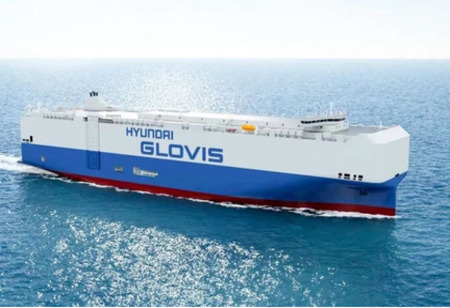
Earlier, Hyundai Glovis announced the deployment of the ultra-large pure car and truck carrier (PCTC) Glovis Leader, which can transport 10,800 vehicles, for finished-vehicle maritime shipping. The ship is 230 meters long and 40 meters wide, having a gross tonnage of 102,590 tons. Its cargo area is comparable to roughly 28 football fields. Hyundai Glovis is the inaugural global car carrier operator to launch a PCTC that can hold over 10,000 vehicles.
The Glovis Leader features a dual-fuel propulsion engine powered by liquefied natural gas and an alternative maritime power (AMP) system, allowing it to meet stringent global environmental regulations, such as the European Union's emissions trading system. The AMP system enables the ship to utilize shore power while at the dock, cutting down air pollutant emissions by removing the need for onboard fuel-generated electricity.
Hyundai Glovis intends to utilize the Glovis Leader on its international shipping routes. By the year 2030, the firm plans to grow its PCTC fleet to 128 ships and carry 5 million vehicles each year — a quantity anticipated to represent over 20 percent of worldwide shipments.
Also Read: Industry Minister Shows Confidence in Korea's Submarine Bid
The company aims to boost nonaffiliated cargo by securing more maritime transport agreements with original equipment manufacturers in Europe, North America, and China. In the previous year, nonaffiliated cargo represented 53 percent of Hyundai Glovis’ revenue from finished-vehicle shipping.