


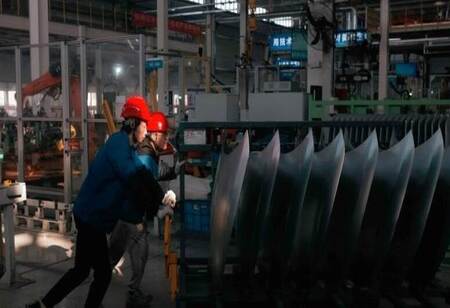
 Japan's manufacturing sector experienced declining growth rates during March, and the early
Signs of the conflict in the Middle East are beginning to show in the Japanese manufacturing industry, according to a survey released on Tuesday. The S&P Global flash Japan Manufacturing Purchasing Managers' Index was recorded at 51.4, which is lower than the nearly 4-year-high of 53.0 registered during February.
The factory output delivery index from the manufacturing Purchasing Managers' Index also showed a slower rate of expansion than February. The orders index, including those placed by non-Japanese customers, raised its weakest performance in three months, and had only begun to increase in January.
This data may be an indication of an emerging concern for Japanese manufacturers dealing with the negative effects of a weakening yen, rising input costs due to a rise in energy prices, and the impact of continuing geopolitical uncertainty. As a result, while input costs held stable, the rate of input cost inflation has risen to 1-year highs as the result of increased energy and labor costs, respectively.
Similarly to the manufacturing sector, the service sector also showed a slowing of growth rates during March, as the flash Japan services PMI decreased from 53.8 to 52.8 during February 2023. However, both of these indices continue to show growth, and the services PMI remains positive for the 12th consecutive month.
PMI results that are greater than 50 represent improvements in reported production following previously lower levels of production; those below 50 represent decreases in production that followed previously higher levels of production.
The composite PMI for Japan decreased to 52.5 during March from 53.9 during February, its lowest reading over the last three months.
Also Read: Spotlight, BMW's China Venture, to Make EVs and Mini Cars Globally
Looking ahead, Japanese manufacturers remain more optimistic regarding future production levels compared to any month last year, while services sentiment has weakened to its lowest level since August 2020 because of the uncertainty caused by the ongoing geopolitical situation.
Also Read: Gentari Launches Clean Energy Platform 'Gentari Go' in Asia Pacific
According to Annabel Fiddes, a Director of Economics at S&P Global Market Intelligence, “There is considerable uncertainty regarding the length and effects of the Middle East War; therefore, companies were expecting weak futures.”
Also Read: Maneuvring the Dynamics of Thai Real Estate Market Trends 2024
The services companies experienced a much larger decline in expectations for future production than did manufacturers; however, manufacturers believe that future growth in their traditional industries will continue to drive the Japanese economy forward in the coming months.